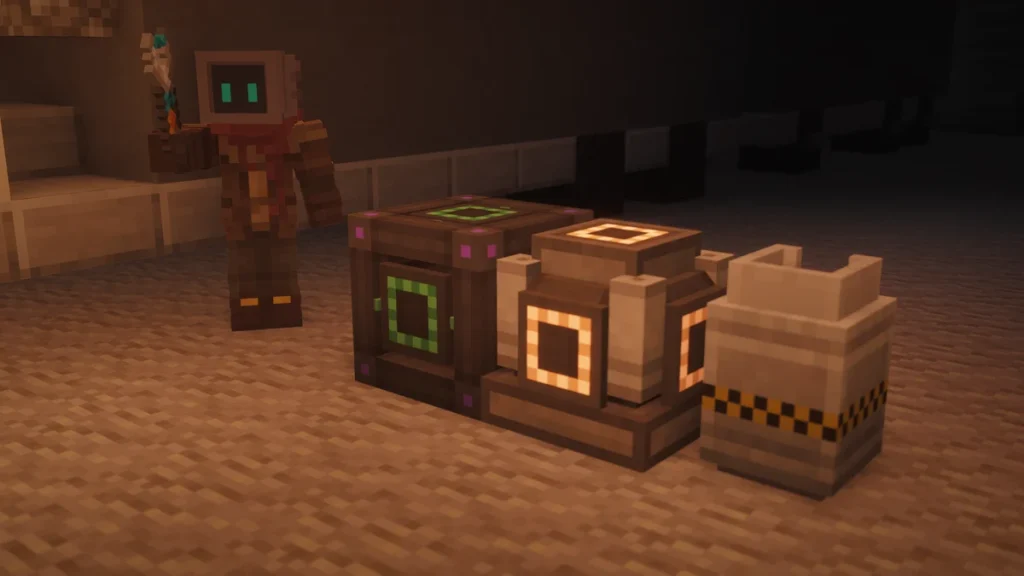
The  Gas-Burning Generator is a Mekanism generator that burns Hydrogen or Ethene, and on Ethene it’s the strongest power source you’ll have before the reactors. One of them is able to reach 72,192 FE/t (180,480 J/t) with a full tank, which is the same as over 500
 Bio-Generators.
To use it, you’ll pipe the fuel into any side except the front with Pressurized Tubes, and take the power from the front. The fuel you pick matters a lot though, as Ethene holds 141 times more energy than Hydrogen does.
How to Make It
It’s crafted from 4  Osmium Ingots, 2
 Infused Alloy, 2
 Steel Casings and an
 Electrolytic Core. The core goes in the middle with a Steel Casing either side, and the Osmium sits in the four corners.


The Electrolytic Core is the costly part, as it takes 5 Infused Alloy along with some Osmium, Iron and  Gold Dust. You’ll be making a second one for the
 Electrolytic Separator anyway, which is the machine that supplies the Hydrogen.
How It Works
The generator has an 18 bucket tank, and how fast it burns depends on how full that tank is. With only a little fuel inside it’ll burn slowly, and it speeds up as the tank fills, reaching its top rate when it’s completely full.

What this means in practice is that the output settles at whatever rate you’re feeding it. A small steady supply gives a small steady output with a nearly empty tank, and the tank will only start filling once you’re sending in more than your machines are using.
| Tank | On Hydrogen | On Ethene |
|---|---|---|
| Full | 20,480 FE/t | 72,192 FE/t |
| Half full | 10,240 FE/t | 36,096 FE/t |
| 10% full | 2,080 FE/t | 7,332 FE/t |
| Almost empty | 80 FE/t | 282 FE/t |
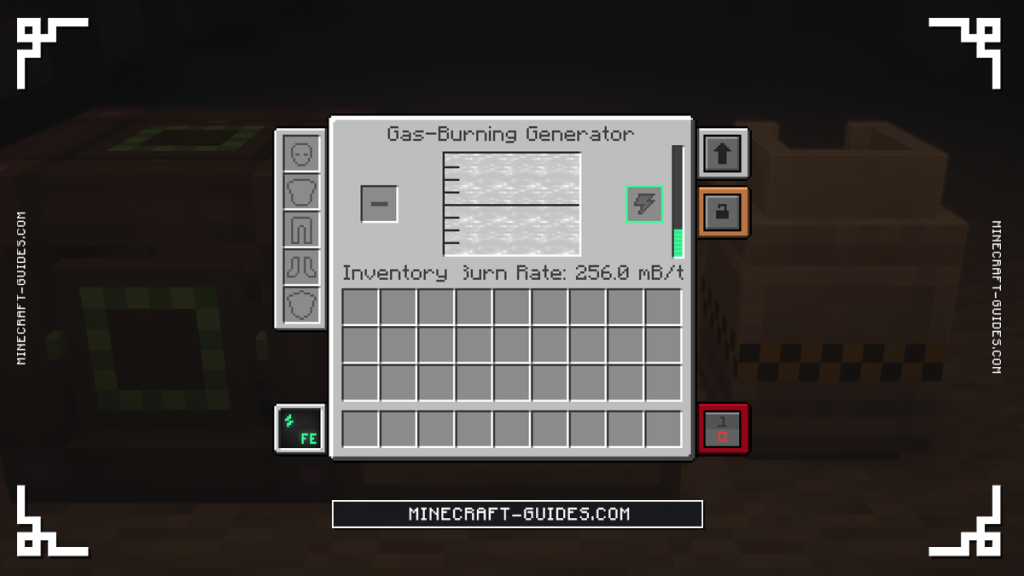
It’ll never burn more than its 80,000 FE buffer has room for, so fuel isn’t wasted when nothing is drawing power. The screen shows the current burn rate in mB per tick, which is the easy way to see how much fuel it’s really getting through.
Getting fuel in and power out
Fuel is accepted on the top, bottom, back, left and right, so a Pressurized Tube can go on any of those. A filled Chemical Tank placed in the slot will empty into the generator as well, which is handy for testing it before the tubes are laid.
The front is the only face that gives out power, and it’s pushed into a cable or an Energy Cube without any setting up. At full output a short run of  Basic Universal Cable won’t keep up, as each piece only holds 3,200 FE, so it’s worth upgrading the cables on it.
Fuels
Only two chemicals will burn, and they’re a long way apart. Hydrogen gives 80 FE for each mB, whereas Ethene gives 11,280 FE, so a single bucket of Ethene is worth over 11 million FE.
| Fuel | Energy per mB | Burned at a Full Tank | A Full Tank Holds |
|---|---|---|---|
| Hydrogen | 80 FE | 256 mB a tick | 1.44 million FE |
| Ethene | 11,280 FE | 6.4 mB a tick | 203 million FE |
At the top rate, a full tank of Hydrogen will be gone in under 4 seconds, whereas the same tank of Ethene lasts for over 2 minutes while giving three and a half times the power. That’s why the tank fills so easily on Ethene and hardly ever does on Hydrogen.
Why Hydrogen is a poor fuel
Hydrogen comes from splitting Water in the Electrolytic Separator, and that costs exactly 80 FE for each mB it makes. So burning it only gives back what you spent, and you’ll end up with no extra power at all from a Water and Hydrogen loop.
Burning Ethene
Ethene (called Ethylene in older versions) is made in the  Pressurized Reaction Chamber from 2
 Bio Fuel, 10 mB of Water and 100 mB of Hydrogen, which gives 100 mB of Ethene. Each mB of Hydrogen becomes one mB of Ethene, so that 80 FE of Hydrogen will come back as 11,280 FE.
A single chamber with no upgrades makes 1 mB of Ethene a tick, and that’s enough for 11,280 FE/t from one generator. It’ll need 24 Bio Fuel a minute and half the output of one Electrolytic Separator to do it, and the Ethene page goes through building that setup.
For the full 72,192 FE/t, the generator has to be fed 6.4 mB of Ethene a tick with the tank kept full. That’s about seven unupgraded chambers, or one with  Speed Upgrades, and around 154 Bio Fuel a minute.
Upgrades and Automation
As with the other generators, the  Muffling Upgrade is the only upgrade it takes. The speed is set by the tank level instead, so the way to get more out of it is always to send more Ethene in.
A Comparator next to it reads how full the fuel tank is, and it has a redstone control setting in its screen. The Pressurized Reaction Chamber pushes its Ethene out of its right side by default, so a Pressurized Tube from that side to the generator is all the link needs, and the side configuration is where you’d change it.
You’re able to run a whole base from two or three of these on Ethene, as they’re so far ahead of everything before them. The Ethene setup is the part worth getting right, since the generator itself needs nothing but tubes and a cable.
FAQ
Pipe Hydrogen or Ethene into the top, bottom, back or either side with Pressurized Tubes, then put a Universal Cable or an Energy Cube against the front. It starts burning as soon as fuel arrives, and the more fuel there is in its tank, the faster it’ll burn and the more power you’ll get.
Ethene is the one to use, as it gives 11,280 FE for each mB whereas Hydrogen only gives 80 FE. Hydrogen also costs as much power to make as it gives back, so it’s only really useful as an ingredient for Ethene or as a way to store energy.
On Ethene it’ll make up to 72,192 FE/t, or 180,480 J/t, with a full tank, and up to 20,480 FE/t on Hydrogen. The output follows the tank level, so with a small supply you’ll see less, like 11,280 FE/t from one Pressurized Reaction Chamber‘s worth of Ethene.
The burn rate is tied to how full the tank is, so a generator with a nearly empty tank will only trickle. It needs more fuel coming in than is being burned before the tank can fill and the output can climb, and the front has to be touching a cable as well.