
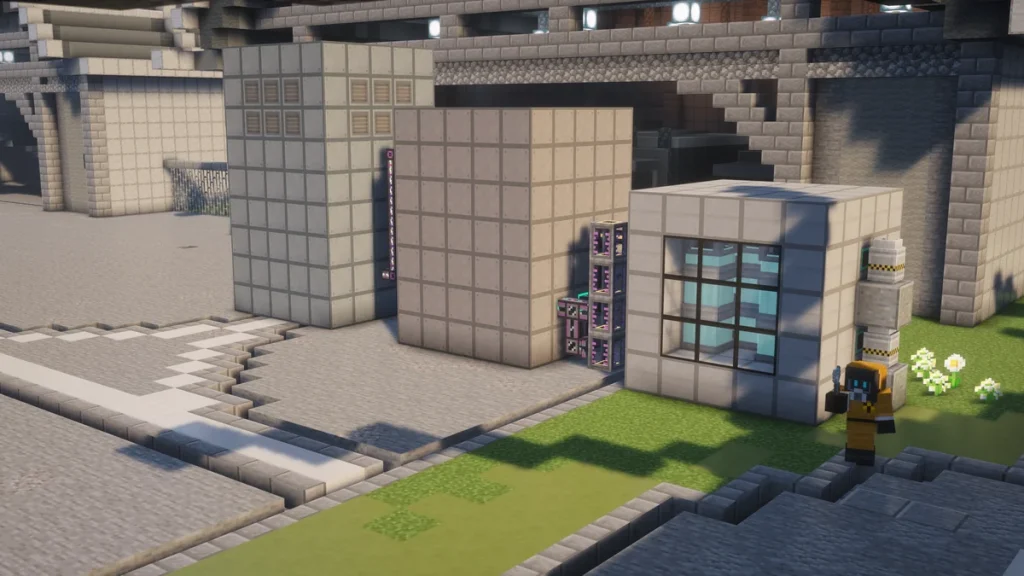
The Thermoelectric Boiler is a Mekanism multiblock that turns Water into Steam using heat, and it’s what sits between a Sodium cooled Fission Reactor and an Industrial Turbine. It’s a hollow box of  Boiler Casing that can be anything from 3x4x3 up to 18x18x18.
Inside it you’ll need one full layer of Pressure Dispersers with at least one Superheating Element underneath, and each element lets it boil up to 320,000 mB of Water a tick, although the size of the boiler tends to limit it first. The heat comes from Superheated Sodium piped in from a reactor, or from  Resistive Heaters placed against the outside.
How to Build It
There are only four parts to craft, and  Structural Glass is optional on top of those. The boiler is a lot simpler than a turbine, as there’s nothing in the middle and no odd numbers to worry about.
| Part | Recipe | Where It Goes |
|---|---|---|
| Boiler Casing | 4 Steel Ingot around an Iron Ingot (makes 4) | Every edge and corner, and any wall block |
| Boiler Valve | 4 Boiler Casing around an Advanced Control Circuit (makes 2) | Any wall face, never an edge |
| Pressure Disperser | 4 Steel Ingot, 4 Iron Bars, 1 Infused Alloy | One complete layer across the inside |
| Superheating Element | 4 Redstone Dust, 4 Copper Ingot, 1 Steel Casing | Inside, below the disperser layer |
The  Superheating Element recipe looks like it wants an alloy in the corners, but the slot it uses is plain
 Redstone Dust. That makes the elements cheap, which is good as a large boiler can need dozens of them.


 4

 2





The  Pressure Disperser is the same block that’s used in the turbine, so it’s worth crafting both lots together. You’ll need at least three
 Boiler Valves for a Sodium boiler, and the recipe gives two at a time.
A first boiler, layer by layer
A 5x5x7 boiler with 4 elements will boil about 670,000 mB a tick on Sodium, which is just under two thirds of what a 5x5x9 turbine can use. The table goes through it from the floor up, and the elements have to be touching each other.
| Layer | Outer Ring | Inside |
|---|---|---|
| 1 (floor) | Solid 5×5 of Boiler Casing | None |
| 2 | Boiler Casing, with the input Boiler Valve | 4 Superheating Elements in a 2×2 square, air in the rest |
| 3 | Boiler Casing | Air |
| 4 | Boiler Casing | 9 Pressure Dispersers filling the layer |
| 5 and 6 | Boiler Casing, with the two output Boiler Valves | Air |
| 7 (roof) | Solid 5×5 of Boiler Casing | None |
That comes to 127 Boiler Casing, 3 Boiler Valves, 9 Pressure Dispersers and 4 Superheating Elements. The space below the dispersers is where the Water and the hot Sodium are held, and the space above them is where the Steam collects.
How It Works
Water and heat go into the lower part, and once the boiler reaches 373 K (which is 100 degrees Celsius) the Water starts turning into Steam above the dispersers. Each mB of Water becomes one mB of Steam, and it costs 50 heat to do it.
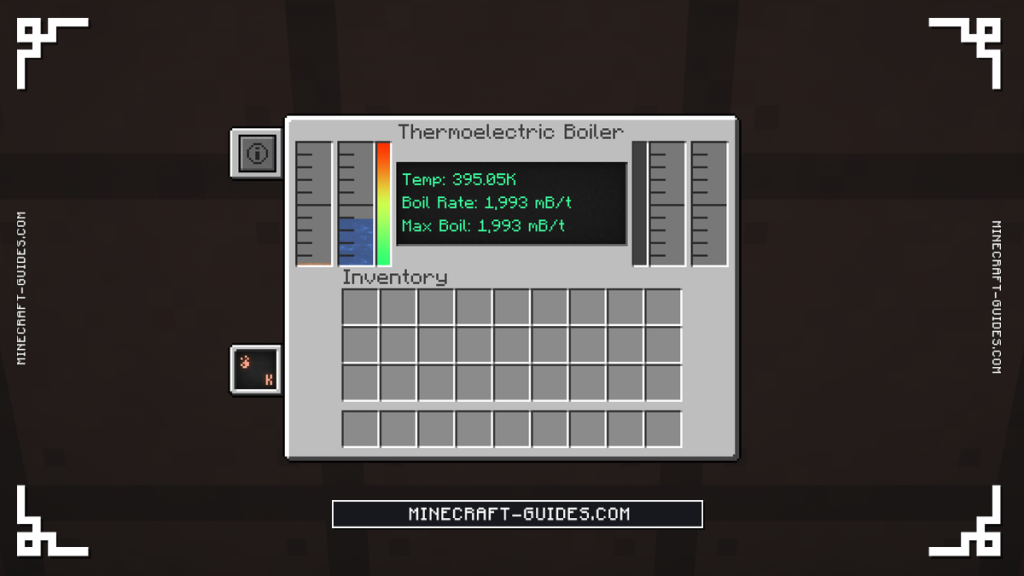
The boil rate is limited by three things, which are the number of elements, how much heat is arriving and how much Water is inside. On Sodium it’s nearly always the heat, as the boiler only cools a small part of its Superheated Sodium each tick. The boiler’s screen shows the current boil rate next to the maximum.
Setting the valves
Every Boiler Valve starts as an input, and it’s changed by sneaking and right-clicking it with a  Configurator. Each click moves it on to the next of three modes, which are input only, output steam and output coolant.
An input valve will take both Water and Superheated Sodium, so one is enough for the two of them. The output valves push their contents out by themselves, so a valve set to output steam can sit directly against a  Turbine Valve or a Pressurized Tube leading to one.
A boiler that fills with Steam and never sends it anywhere has all of its valves still set to input only. Remember to switch one valve to output steam, and one to output coolant if you’re running it on Sodium.
How much it holds
The tanks scale with the size of the two spaces, so a taller boiler holds more of everything. The 5x5x7 one above keeps about 1,136 buckets of Water and 12,000 buckets of Steam, which is plenty to smooth over a short gap in supply.
| Tank | Where | Per Block |
|---|---|---|
| Water | Below the dispersers | 16,000 mB |
| Superheated Sodium | Below the dispersers | 256,000 mB |
| Steam | Above the dispersers | 160,000 mB |
| Sodium (cooled) | Above the dispersers | 256,000 mB |
The space below counts the floor layer and loses one block for each element, whereas the space above counts the roof. Once the Steam tank is full the boiler simply stops boiling, so nothing is lost while the turbine is catching up.
Build Rules
The smallest boiler that will form is 3 wide, 3 long and 4 tall, as the inside needs one layer for an element and one for the dispersers. The sides don’t have to match and they can be odd or even, up to 18 in each direction.
| Part | Where it goes |
|---|---|
| Boiler Casing | Every edge and corner |
| Boiler Valve, Structural Glass | Inside a face, never an edge or corner |
| Pressure Disperser | One full layer across the inside, nowhere else |
| Superheating Element | Below the dispersers, all touching as one group |
The inside can only hold Superheating Elements, Pressure Dispersers and air. The elements don’t have to sit on the floor, but no pocket of air below the dispersers can be walled off by them.
When it won’t form, right-clicking the casing prints the reason in chat, the same as the turbine does. The messages you’re most likely to see are that no Pressure Disperser layer was found, that a disperser is missing at a set of coordinates, or that the Superheating Element arrangement is invalid.
That last one covers three different mistakes, which are having no elements at all, having one above the dispersers, and having two groups that don’t touch. If nothing is printed, the casing itself has a gap or a wrong block in an edge.
Heat Sources
There are two ways to heat a boiler, and they’re meant for very different jobs. Superheated Sodium is the real one, as it carries the heat out of a Fission Reactor, whereas the Resistive Heater only turns power you already have back into Steam.
Superheated Sodium
A Fission Reactor cooled with Sodium sends out 200,000 mB of Superheated Sodium a tick for every 1 mB a tick of burn rate. It takes 10 mB of that to boil 1 mB of Water, so the boiler will make 20,000 mB of Steam a tick for the same burn rate.
That’s exactly the Steam a Water cooled reactor would make directly from the same fuel, so the Sodium loop won’t give you any more power. What it does is keep the reactor’s core cooler at the same burn rate, as Sodium takes the heat away more easily than Water does.
The Sodium isn’t used up, as it cools down inside the boiler and collects above the dispersers. It leaves through the valve set to output coolant, and that’s the one to pipe back to the reactor so the loop keeps going.
Each element covers a burn rate of 16 at most, so a reactor running at 64 needs at least 4 of them. A Water cooled reactor doesn’t need a boiler at all, as it makes its Steam directly and can feed the turbine by itself.
The elements aren’t the only limit on Sodium though, as the boiler will only cool about 4% of its Superheated Sodium tank each tick. That works out at around 9,000 mB of Steam a tick for each block of space below the dispersers. So the 5x5x7 above covers a burn rate of about 33 whatever its elements allow, and a reactor running at 64 needs twice the space below.
The calculator below will size a boiler around those numbers. Enter the dimensions and how many Superheating Elements you’re placing, and it’ll show the burn rate that the boiler covers on Sodium, how much Steam it makes each tick and whether its size or its elements are the limit.
Thermoelectric Boiler Calculator
Thermoelectric Boiler sizes on Superheated Sodium, with the inside split evenly around the Pressure Disperser layer.
| Size | Superheating Elements | Max Boil Rate | Burn Rate Covered | Water Tank | Steam Tank |
|---|---|---|---|---|---|
| 3x4x3 | 1 | 161,607 mB/t | 8 mB/t | 272,000 mB | 1,440,000 mB |
| 5x5x7 | 4 | 670,730 mB/t | 33.5 mB/t | 1,136,000 mB | 12,000,000 mB |
| 7x7x9 | 25 | 1,594,533 mB/t | 79.7 mB/t | 2,736,000 mB | 31,360,000 mB |
| 9x9x11 | 49 | 3,255,088 mB/t | 162.7 mB/t | 5,696,000 mB | 64,800,000 mB |
| 18x18x18 | 256 | 22,167,648 mB/t | 1,108.3 mB/t | 42,560,000 mB | 414,720,000 mB |
Parts: Boiler Casing, Boiler Valve, Pressure Disperser, Superheating Element.
Resistive Heaters
A Resistive Heater placed against the casing should pass its heat into the boiler, and it gives 1.5 heat for every FE it uses. That works out at about 33 FE for each mB of Steam, and the best turbine only gets 4 FE back from it.
So a heater fed boiler loses nearly nine tenths of the power you put in, and it’ll never pay for itself. It’s only useful for testing a turbine before the reactor is ready, or for a build that’s there to look good.
Upgrades and Automation
The boiler takes no upgrades, so more Steam always means a bigger boiler with more elements in it. A Comparator against a Boiler Valve reads how full the Water tank is, which is a simple way to raise an alarm before it runs dry.
Water has to be pushed in, as the valve won’t pull it, so a Mechanical Pipe from an  Electric Pump or from the turbine’s vents is what you’ll want on the input. The Water coming back from the turbine’s
 Saturating Condensers will cover most of it once the loop is running.
The Steam is no use by itself, so the valve set to output steam should lead straight into a turbine. That’s the Industrial Turbine, which is the next part of the setup to build, and it’s the one that sends the Water back.
FAQ
Build a hollow box of Boiler Casing at least 3x4x3, with a complete layer of Pressure Dispersers across the inside and one or more Superheating Elements below it, all touching. Add Boiler Valves on the wall faces, then use a Configurator to set one to output steam and another to output coolant.
New Boiler Valves are all set to input only, so nothing leaves until one is changed. Sneak and right-click a valve with a Configurator to switch it to output steam, and it’ll start pushing Steam into whatever is touching it, like a Turbine Valve.
Each element boils up to 320,000 mB of Water a tick, which covers a burn rate of 16 on a Sodium cooled Fission Reactor. The size of the boiler matters as well though, as it’ll only boil around 9,000 mB a tick for each block of space below the Pressure Dispersers. One element for every 35 blocks of that space is plenty, and they all have to be connected.
It’ll work, but it takes about 33 FE of heating to make each mB of Steam and a turbine returns 4 FE at most. That means you’d lose most of the power going round, so heaters are only really for testing, whereas Superheated Sodium from a reactor is the proper heat source.


