
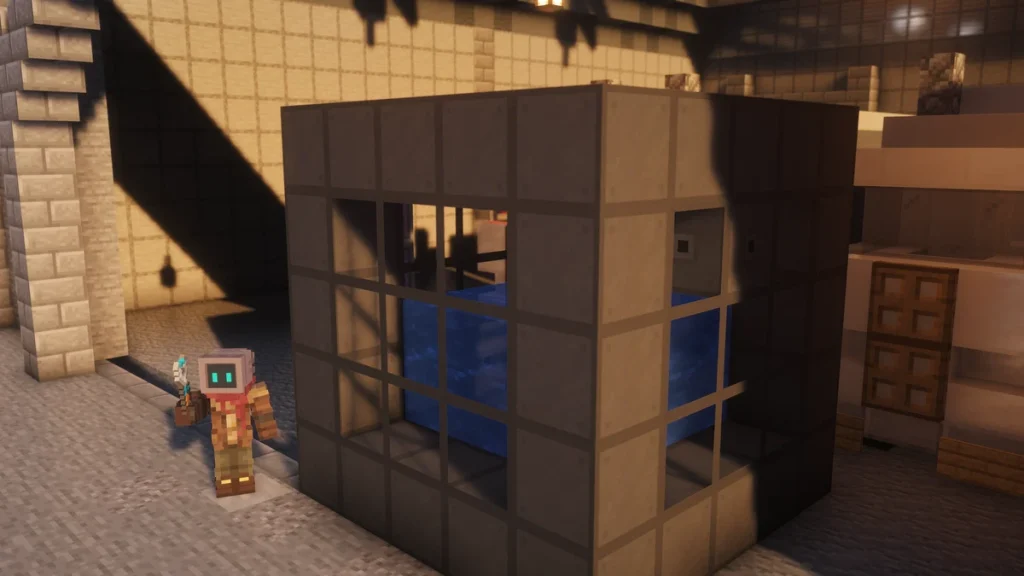
The Dynamic Tank is a Mekanism multiblock that stores a huge amount of one fluid or one chemical, and you’re able to build it at any size from 3x3x3 up to 18x18x18. It’s a hollow box made from Dynamic Tank blocks, with at least one Dynamic Valve in a wall so that pipes are able to get in and out.
Even the smallest one holds 9,450 buckets of fluid, which is as much as 295  Basic Fluid Tanks, and it only needs 26 blocks. The capacity goes up with the size of the whole box, so every block you add to its length, width or height is worth building.
How to Build It
Parts
The three parts are all cheap. A  Dynamic Tank recipe gives four blocks from four
 Steel Ingots around a
 Bucket, the
 Dynamic Valve gives two from four Dynamic Tank blocks around a
 Basic Control Circuit, and
 Structural Glass gives four from four Steel Ingots around a block of
 Glass.



 4

 2

 4
Most of what you’ll craft is the Dynamic Tank block itself, as it makes up the whole frame. One valve is enough for a tank to work, though two are easier to live with, as you’re able to keep one for the pipe coming in and one for the pipe going out.
Frame and Faces
Build a box that’s between 3 and 18 blocks along each side, and the three sides don’t have to match, so a 5x3x9 tank is fine. Every edge and every corner of the box has to be a Dynamic Tank block, as that’s the frame the game looks for.
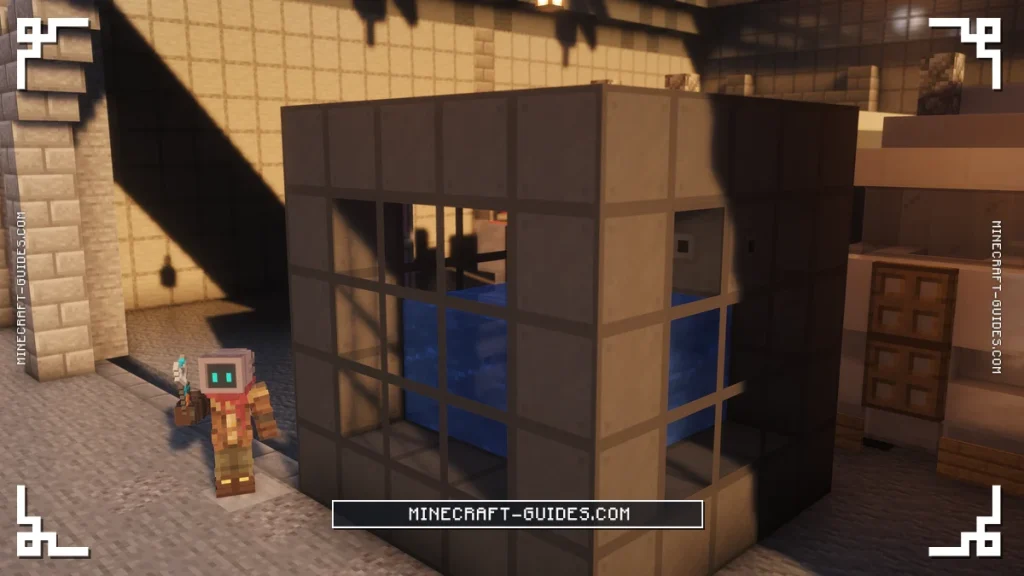
The flat part of each face, inside the frame, can be Dynamic Tank blocks, Dynamic Valves or Structural Glass in any mix you like. The inside of the box has to be left completely empty, with nothing but air in it, and the tank should form on its own once the last block goes in.
| Part of the Box | Allowed Blocks |
|---|---|
| Edges and corners | Dynamic Tank only |
| Face interiors | Dynamic Tank, Dynamic Valve or Structural Glass |
| Inside | Air only |
For the smallest 3x3x3 tank, that’s 20 frame blocks and one block in the middle of each of the six faces, so you’ll need 26 pieces in all. A 5x5x5 needs 98, where 44 of them are frame and the other 54 can be Glass or valves if you’d like to see inside.
How It Works
A formed tank holds either one fluid or one chemical, but never both at the same time. Whichever goes in first decides it, so a tank with Water in it won’t accept Hydrogen until it’s been emptied again. Right-clicking any block of the tank opens its screen, which shows what’s inside and how full it is.
Everything goes in and out through the Dynamic Valves, and you can have as many of them as you like. A valve accepts fluid from a Mechanical Pipe or chemicals from a Pressurized Tube, and you’ll connect the pipe that’s taking them back out to a valve as well.
A Dynamic Valve has no auto-eject at all. To take fluid out, sneak and right-click the pipe’s side on the valve with a  Configurator until it says Pull, as a pipe left on Normal will fill the tank and never empty it.
The screen has bucket slots as well, with the same Both, Fill and Empty button that a Fluid Tank has, so you’re able to fill or drain it by hand. A  Gauge Dropper works on the gauge too, which is the quick way to throw away what’s inside.
Sizes and Capacity
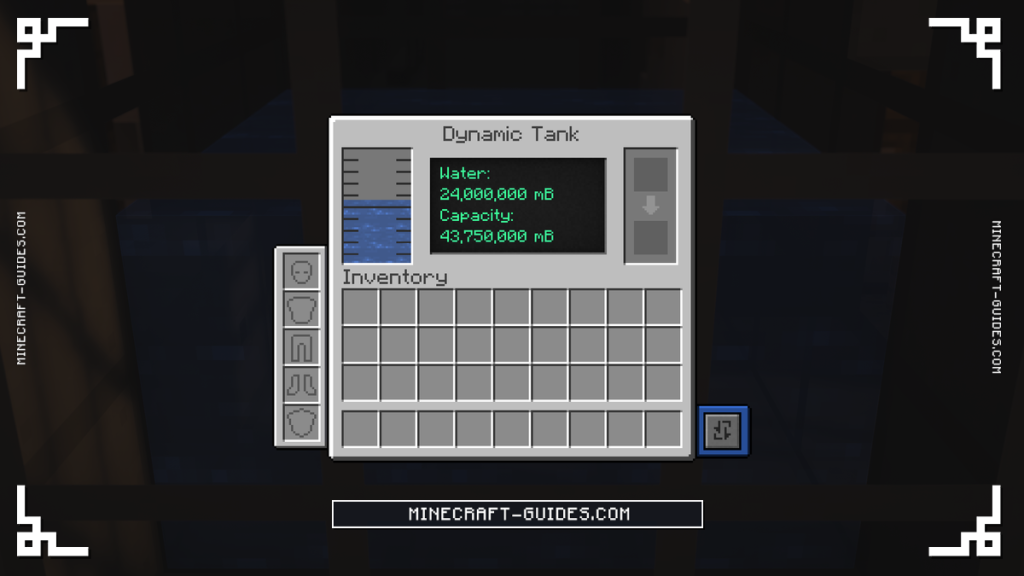
Capacity is worked out from the outside of the box, so the walls count as well as the space inside. Each block of that volume adds 350,000 mB for a fluid or 16,000,000 mB for a chemical, which means you’ll multiply length by width by height and then by one of those two numbers.
| Outer Size | Fluid | Chemical |
|---|---|---|
| 3x3x3 | 9,450,000 mB | 432,000,000 mB |
| 5x5x5 | 43,750,000 mB | 2,000,000,000 mB |
| 9x9x9 | 255,150,000 mB | 11,664,000,000 mB |
| 18x18x18 | 2,041,200,000 mB | 93,312,000,000 mB |
As a worked example, a 5x3x9 tank has a volume of 135 blocks, so it holds 47,250,000 mB of fluid, which is 47,250 buckets. The biggest tank possible holds just over 2 million buckets, which is far more than any base is likely to fill.
Why It Won’t Form
Most of the time it’ll be a valve or some Glass that’s been placed on an edge, as the frame will only accept Dynamic Tank blocks. Check the twelve edges and the eight corners first, and swap anything else you find there for a casing block.
The next thing to check is the inside, as anything that’s been left in there will stop it, even if it’s just a  Torch or some Water. A side that’s shorter than 3 or longer than 18 won’t form either, and neither will a box with a hole in one of its faces.
Structural Glass is the right Glass for this tank, and it works in most other Mekanism multiblocks too. The two reactors are the exception, as they need  Reactor Glass instead, although you’re able to use that one in a Dynamic Tank as well if you want to.
Upgrades and Automation
A Dynamic Tank doesn’t use energy and doesn’t take upgrades, as making it bigger is the upgrade. A  Redstone Comparator on a Dynamic Valve reads how full the whole tank is, which can be used to turn a pump off when it’s nearly full.
It won’t accept the radioactive chemicals, the same as a Chemical Tank, so Nuclear Waste still has to go into a  Radioactive Waste Barrel. Anything else is fine, and a tank of Water or Brine this size is usually filled by an
 Electric Pump.
FAQ
Build a hollow box that’s 3 to 18 blocks on each side, with Dynamic Tank blocks on every edge and corner. The faces can be more Dynamic Tank blocks, Structural Glass or Dynamic Valves, and you’ll need at least one valve to pipe anything in. Leave the inside empty and it’ll form by itself.
It holds 350,000 mB of fluid or 16,000,000 mB of a chemical for every block of its outer volume. A 3x3x3 holds 9,450 buckets of fluid, whereas the largest 18x18x18 holds 2,041,200 buckets.
A Dynamic Tank holds chemicals as well as fluids, so Hydrogen, Oxygen, Steam and the rest will all go in through a Dynamic Valve with a Pressurized Tube. It only holds one thing at a time though, and it refuses the radioactive ones like Nuclear Waste.
It’s nearly always a valve or a piece of Glass on an edge or corner, as those have to be Dynamic Tank blocks. It might also be a block left inside, as the middle has to be air, or a side that’s under 3 or over 18 blocks long.


