
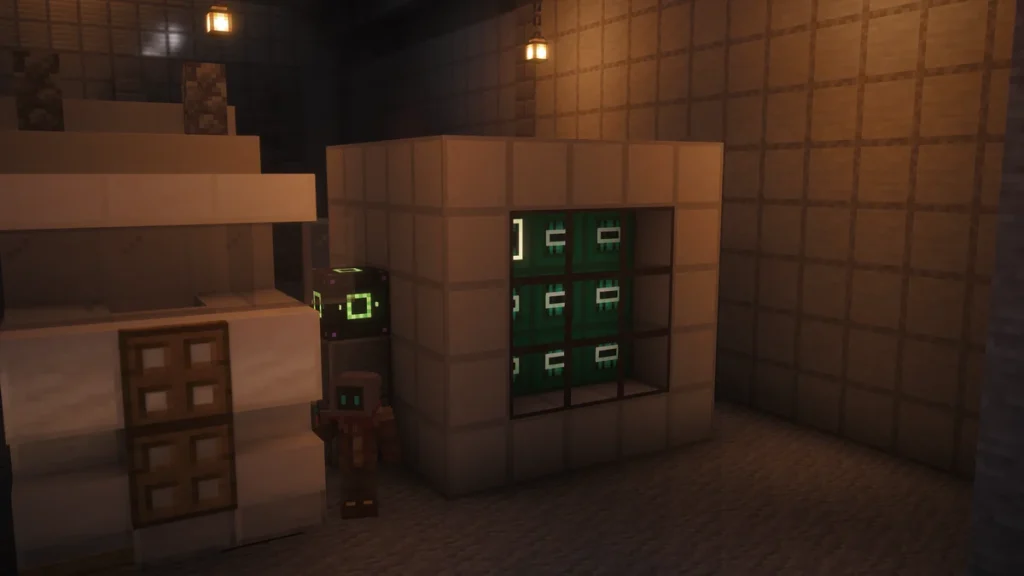
The Induction Matrix is Mekanism’s large battery, which is a hollow multiblock that you fill with cells to store power. It’s built as a box of  Induction Casing with
 Induction Ports in its faces, and even the cheapest
 Basic Induction Cell holds 3.2 billion FE (8 billion J), which is more than 31
 Ultimate Energy Cubes.
There are two kinds of block that go inside, and you’ll need both of them. Induction Cells set how much power the matrix can hold, whereas Induction Providers set how fast it’s able to take power in and give it out, so a matrix with no providers won’t charge at all.
How to Build It
Induction Casing is crafted 4 at a time from 4  Steel Ingots around an
 Energy Tablet, and it makes up most of the shell. An Induction Port is how power gets in and out, and you’ll get 2 of them from 4 casings around an
 Elite Control Circuit, so the matrix isn’t something you’ll be building in the first few hours.


 4

 2
The cells and providers are the expensive part, as the Basic ones both need 4  Lithium Dust and a
 Basic Energy Cube. The Basic Induction Cell adds 4 Energy Tablets to that, and the
 Basic Induction Provider adds 4
 Basic Control Circuits instead. The Lithium page covers where the dust comes from, as it needs a Thermal Evaporation Plant.
Build Rules
The matrix is a hollow box, and each of its 3 sides can be anywhere from 3 to 18 blocks long, so it doesn’t have to be a cube. Every edge and corner has to be Induction Casing. Ports are only allowed in the flat part of a face, and the same goes for  Structural Glass, which you’re able to use in place of casing there to see inside.
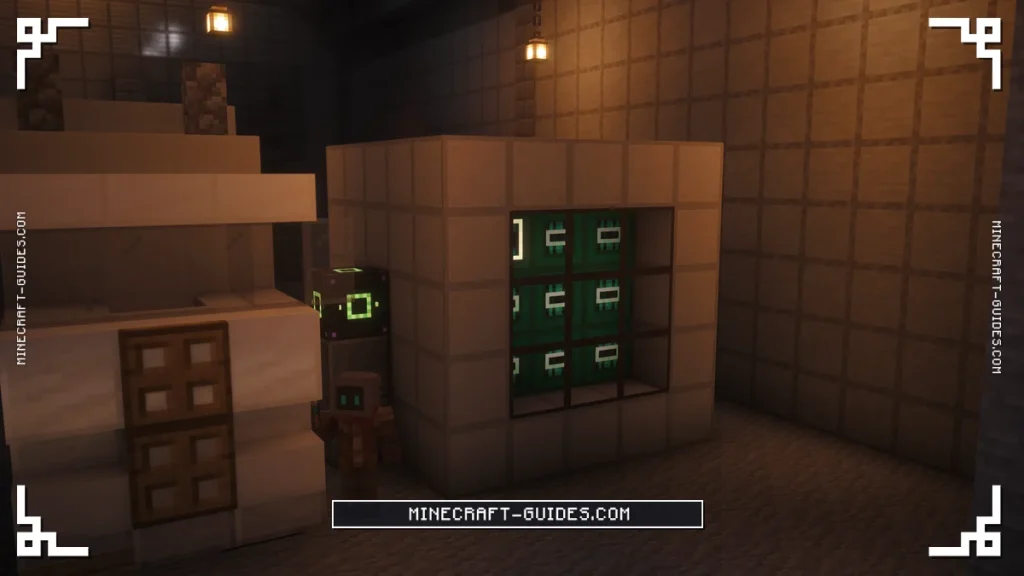
Inside the box, the only blocks that are allowed are Induction Cells, Induction Providers and air. They don’t have to touch each other or be placed in any pattern, and you’re able to leave gaps and fill them in later, as the matrix will count whatever is in there when it forms.
The Smallest Matrix
A 3x3x3 box will form, but it only has a single block of space inside, so it can hold one cell or one provider and never both, which makes it useless. The smallest matrix that works is 3x3x4, which has 2 spaces inside for one cell and one provider, and it needs 34 blocks for the shell.
Why It Won’t Form
If you right-click the casing and get a message saying “Couldn’t create frame, invalid block”, there’s a port or a piece of Structural Glass on an edge or corner, or a block is missing from the shell. The message gives the position of the block that’s wrong, which makes it quick to find.
The other message is “Inner structure contains an illegal block”, which means there’s something inside that isn’t a cell or a provider, like a cable, a  Torch or a block you stood on. It also won’t form if any side is longer than 18 blocks.
How It Works
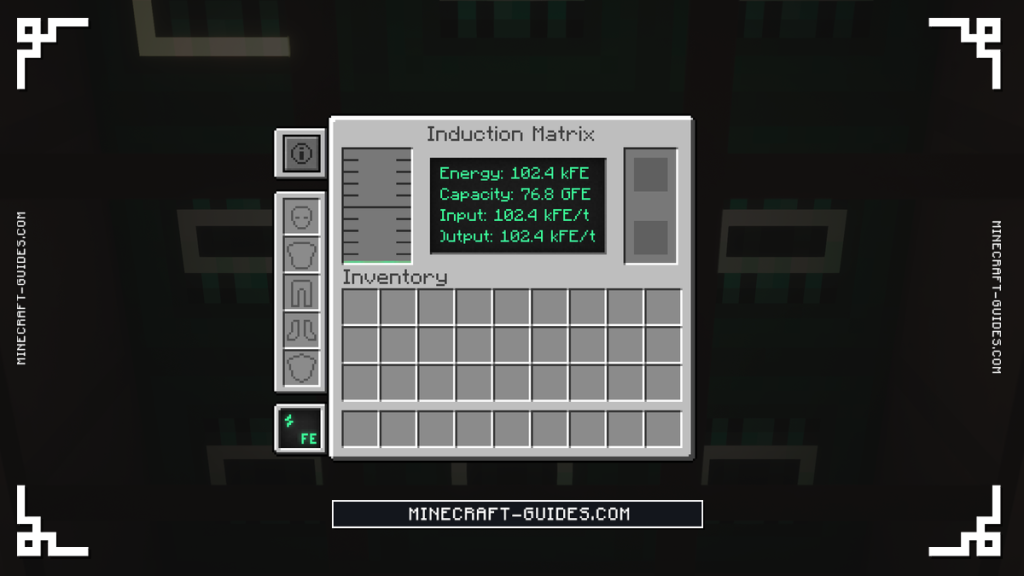
Once it’s formed, the matrix adds up every Induction Cell inside for its capacity, and every Induction Provider for its transfer rate. That rate is counted separately for power going in and power coming out, so a matrix with one Basic provider is able to take in 102,400 FE/t and give out 102,400 FE/t at the same time.
Every Induction Port starts as an input, so a new matrix will fill up and never give anything back. To change one, sneak and right-click the port with a  Configurator, which switches it to output, and it’ll then push power into whatever cable or machine is attached to it.
The transfer rate is a hard cap for the whole matrix, and it doesn’t matter how many ports there are. If your generators make more than the providers allow, the extra will just be refused, so it’s worth checking the Input figure in the Matrix Statistics tab against what you’re producing.
Right-clicking the casing opens its screen, which shows how full it is along with how much is being received and sent each tick. There are 2 item slots in there as well, which work like the ones in an Energy Cube, with one to charge an item and one to drain it.
Cells and Providers
Both come in 4 tiers, and each tier is worth about 8 times the one below it. You’re able to mix tiers freely inside the same matrix, so there’s no need to rebuild it when you start making better cells.
| Tier | Cell Capacity | Provider Rate |
|---|---|---|
| Basic | 3.2 billion FE | 102,400 FE/t |
| Advanced | 25.6 billion FE | 819,200 FE/t |
| Elite | 204.8 billion FE | 6,553,600 FE/t |
| Ultimate | 1.6 trillion FE | 52,428,800 FE/t |
The catch is in the recipes, as every higher cell is crafted from 4 cells of the tier below, with 4 Energy Tablets and an Energy Cube of the new tier. Providers follow the same pattern with 4 Control Circuits of the new tier. So an Ultimate Induction Cell is 64 Basic cells’ worth of crafting, which works out at 256 Lithium Dust for one block.


This means a higher tier gives you around 8 times the storage for 4 times the materials, in a quarter of the space. If there’s room in the matrix, 4 Basic cells will hold half as much as the Advanced cell they’d be crafted into, so upgrading is always worth it once you’ve got the cubes.
Sizes and Capacity
The space inside is the size of the box with 2 taken off each side, so a 5x5x5 has 27 spaces and an 18x18x18 has 4,096. Every provider you add takes a space that a cell could have used, so you’ll want just enough providers to cover what your generators make.
| Size | Shell Blocks | Inside | Capacity | Transfer Rate |
|---|---|---|---|---|
| 3x3x4 | 34 | 1 Basic cell, 1 Basic provider | 3.2 billion FE | 102,400 FE/t |
| 5x5x5 | 98 | 24 Basic cells, 3 Basic providers | 76.8 billion FE | 307,200 FE/t |
| 5x5x5 | 98 | 24 Ultimate cells, 3 Ultimate providers | 38.4 trillion FE | 157,286,400 FE/t |
| 18x18x18 | 1,736 | 4,095 Ultimate cells, 1 Ultimate provider | 6.552 quadrillion FE | 52,428,800 FE/t |
To size the providers, take what you generate and divide it by the rate of the provider tier you’re using. A Fusion Reactor at its highest setting makes 19.6 million FE/t, which is covered by 3 Elite providers or a single Ultimate one, and anything smaller, like a  Gas-Burning Generator, fits inside one Basic provider.
For a size or a mix of tiers that isn’t in the table, the calculator below will add it up for you. It takes the dimensions and the number of providers, fills the remaining space with cells, and gives the capacity, the transfer rate and the blocks for the shell.
Induction Matrix Calculator
Example Induction Matrix builds, with Induction Cells in every space the Induction Providers leave.
| Size | Shell Blocks | Inside | Capacity | Transfer Rate |
|---|---|---|---|---|
| 3x3x4 | 34 | 1 Basic cell, 1 Basic provider | 3.2 billion FE | 102,400 FE/t |
| 5x5x5 | 98 | 24 Basic cells, 3 Basic providers | 76.8 billion FE | 307,200 FE/t |
| 5x5x5 | 98 | 24 Ultimate cells, 3 Ultimate providers | 38.4 trillion FE | 157,286,400 FE/t |
| 18x18x18 | 1,736 | 4,095 Ultimate cells, 1 Ultimate provider | 6.55 quadrillion FE | 52,428,800 FE/t |
Parts: Induction Casing, Induction Port, Basic Induction Cell,  Advanced Induction Cell,
 Elite Induction Cell,
 Ultimate Induction Cell, Basic Induction Provider,
 Advanced Induction Provider,
 Elite Induction Provider,
 Ultimate Induction Provider.
Upgrades and Automation
The matrix doesn’t take upgrades, as adding cells and providers is how it grows. To do that, you’ll need to break in through the shell, place the new blocks and close it back up, and it’ll form again with the new totals.
A Comparator next to a port will give a signal based on how full the matrix is, which is a simple way to switch generators off when it’s nearly full. You’re able to use as many ports as you like, and it’s common to put the inputs on one face and the outputs on another.
Keep in mind that the cables are a limit of their own, as a line of Basic cables can’t carry what a few Elite providers are able to send. The Universal Cable page covers which cable tier can keep up with it.
FAQ
Build a hollow box from Induction Casing that’s between 3 and 18 blocks on each side, with casing on every edge and corner. Put at least one Induction Port in a face, then fill the inside with Induction Cells and at least one Induction Provider, and it’ll form by itself.
It depends on the cells inside, as a Basic Induction Cell holds 3.2 billion FE and each tier above holds about 8 times more, up to 1.6 trillion FE for an Ultimate one. The largest matrix has room for 4,096 blocks inside, which is over 6.5 quadrillion FE when it’s filled with Ultimate cells.
If it won’t charge, there are probably no Induction Providers inside, as they set the transfer rate and it’s 0 without them. If it charges but won’t give power out, the ports are all still inputs, so sneak and right-click one with a Configurator to make it an output.
The smallest one that works is 3x3x4, as it has 2 spaces inside for one Induction Cell and one Induction Provider. A 3x3x3 will form as well, but with only one space it can’t hold both, so it either stores nothing or can’t move any power.


