
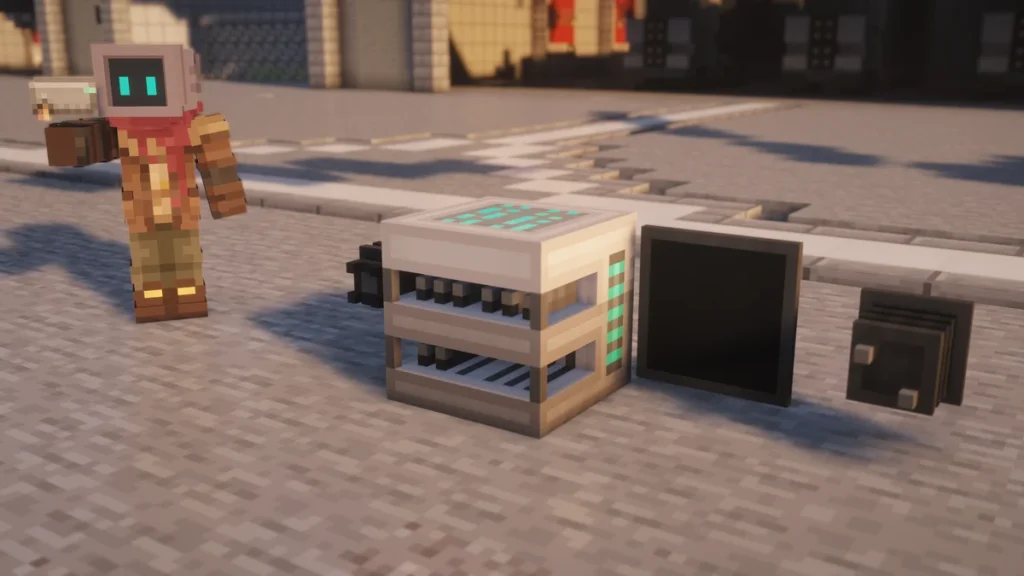
QIO is Mekanism’s digital storage system, where items are kept on drives inside a  QIO Drive Array and reached from a
 QIO Dashboard anywhere in the world. Its blocks aren’t joined by cables at all, as they’re linked by a frequency that you’ll pick in each one’s screen, and none of them use any energy.
To get a working system you’ll need one Drive Array, at least one  QIO Drive to put in it, and a Dashboard set to the same frequency. The first drive holds 16,000 items of up to 128 different types, and the larger drives come later, as they need pellets from a Fission Reactor.
How to Make It
Every QIO block is built from  Teleportation Cores and
 Ultimate Control Circuits, so the whole system sits behind
 Atomic Alloy. The QIO Drive Array takes 4 cores, 2 circuits, a
 Glass Pane, an
 Ender Pearl and either a
 Personal Chest or a
 Personal Barrel in the middle.


The QIO Dashboard is cheaper, needing 4  Lead Ingots, 3 Ender Pearls, a Glass Pane and one core. A QIO Drive is made from 4 Lead Ingots and 4 Ultimate Control Circuits around an Ender Pearl, so the circuits are where most of the cost goes.
If you’re playing on 1.20.1, these recipes were different, as the first drive, the Drive Array and the other blocks all needed  Polonium Pellets. That put the whole system behind a reactor, whereas now only the bigger drives and the portable dashboard need them.
How It Works
A frequency is a named channel that holds the items, and it belongs to the player who made it. You’ll create one in the screen of the first QIO block you place, then choose that same frequency in every other block, and it can be set to public, private or trusted players only.
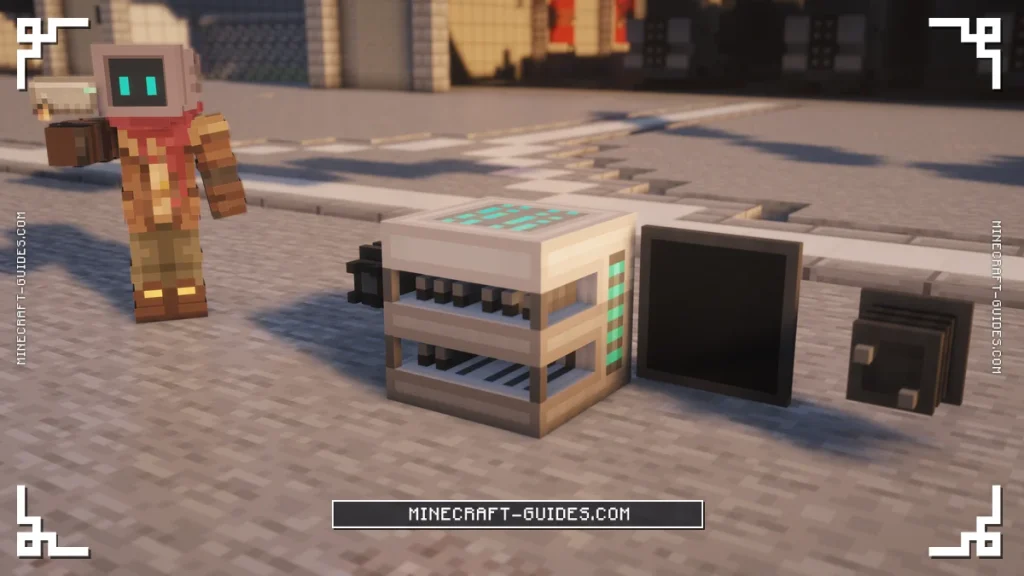
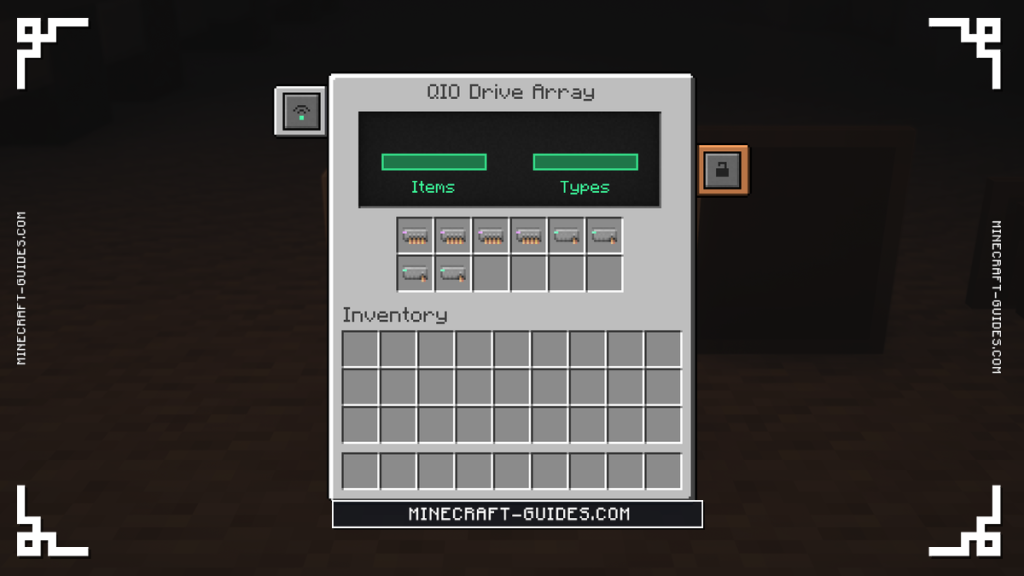
The space on a frequency comes from the drives in every QIO Drive Array set to it, and each array has 12 drive slots. So you’re able to add more arrays whenever the first one is full, and they don’t need to be near each other, or even in the same dimension.
The QIO Dashboard is placed on the face of a block like a monitor, and opening it shows everything on the frequency with a search bar and sorting by name, count, mod or item ID. It’s got 3 crafting windows built in as well, which pull their ingredients straight from storage.
Each drive has a limit on its total items and another on how many different types it can hold. A system full of tools and enchanted gear will usually run out of types long before it runs out of item space.
QIO Drives
There are four drives, and each one is crafted from 4 of the drive before it. That means a  Supermassive QIO Drive takes 64 of the base QIO Drives to make, along with pellets at every step.
| Drive | Items | Item Types | Crafted From |
|---|---|---|---|
| QIO Drive | 16,000 | 128 | 4 Lead Ingot, 4 Ultimate Control Circuit, Ender Pearl |
| Hyper-Dense QIO Drive | 128,000 | 256 | 4 QIO Drive, 4 Plutonium Pellet, Teleportation Core |
| Time-Dilating QIO Drive | 1,048,000 | 1,024 | 4 Hyper-Dense QIO Drive, 4 Plutonium Pellet, Polonium Pellet |
| Supermassive QIO Drive | 16,000,000,000 | 8,192 | 4 Time-Dilating QIO Drive, 4 Polonium Pellet, Antimatter Pellet |
The base drive works out at 250 stacks, so a full array of 12 will hold 192,000 items across 1,536 types. That’s enough for a long time, and the  Hyper-Dense QIO Drive is the next step once you have
 Plutonium Pellets coming out of a reactor.


The Supermassive drive needs an  Antimatter Pellet from the Supercritical Phase Shifter, so it’s an endgame item. One of them holds 16 billion items, which is far more than the other three put together, and its type limit of 8,192 is the part you’d actually notice.
Importers, Exporters and the Redstone Adapter
A  QIO Importer is placed on a block like a
 Chest or a machine, and it’ll pull items out of that block into the frequency. The
 QIO Exporter does the opposite, pushing items from the frequency into the block it’s placed on, and both are crafted the same way, with a
 Sticky Piston for the importer and a
 Piston for the exporter.


Both of them act twice a second and move up to 64 items of one type each time. They take Item, Tag and Mod ID filters to choose what goes through, and the exporter has a Round robin option, which spreads items between every inventory on a Logistical Transporter it’s feeding.
The  QIO Redstone Adapter watches one item on the frequency and gives off a redstone signal once the stored amount reaches the trigger count you’ve typed in. It can be set to ignore NBT, so damaged or enchanted copies are counted together, and it’s the way to switch a farm or a factory off when you have enough of something, like a
 Formulaic Assemblicator that’s crafting into the system.
Portable QIO Dashboard
The  Portable QIO Dashboard is the same screen as an item, with the same 3 crafting windows, and it’ll work from anywhere once it’s set to a frequency. It’s crafted from a QIO Dashboard with 7 Polonium Pellets and a Teleportation Core, so it’s something you’ll make after the reactor is running.
Upgrades and Automation
The Drive Array, the Dashboard and the Redstone Adapter don’t take any upgrades. The importer and exporter take  Speed Upgrades only, up to 8, and each one adds 32 items to every move, with an extra item type for every two upgrades.
So with 8 Speed Upgrades an importer will move 320 items of up to 5 types, twice a second. That’s quick enough to empty the output of a  Digital Miner or a full set of factories, and it still costs no energy to run.
QIO only stores items, so fluids, chemicals and energy need another way to travel. That’s the job of the  Quantum Entangloporter, which uses a frequency in the same way but carries all of those between two blocks instead, and it’s a good one to read about next.
FAQ
Place a QIO Drive Array, put at least one QIO Drive in it, and create a frequency in its screen. Then place a QIO Dashboard and set it to the same frequency, and the items will show up there. No cables or power are needed, as the frequency is what links them.
None of the QIO blocks use energy, so the Drive Array, Dashboard, Importer, Exporter and Redstone Adapter will all run without a cable. The cost is in crafting them instead, as each one needs Teleportation Cores and most need Ultimate Control Circuits as well.
The base QIO Drive holds 16,000 items of up to 128 types, whereas the Supermassive QIO Drive holds 16 billion items of up to 8,192 types. A Drive Array has 12 slots, and every array on the same frequency adds its drives to the total.
QIO is for items only, as its drives have no tanks. For fluids you’d use a  Dynamic Tank or Fluid Tanks, and a Quantum Entangloporter is able to move fluids, chemicals and energy over a frequency in a similar way.


