
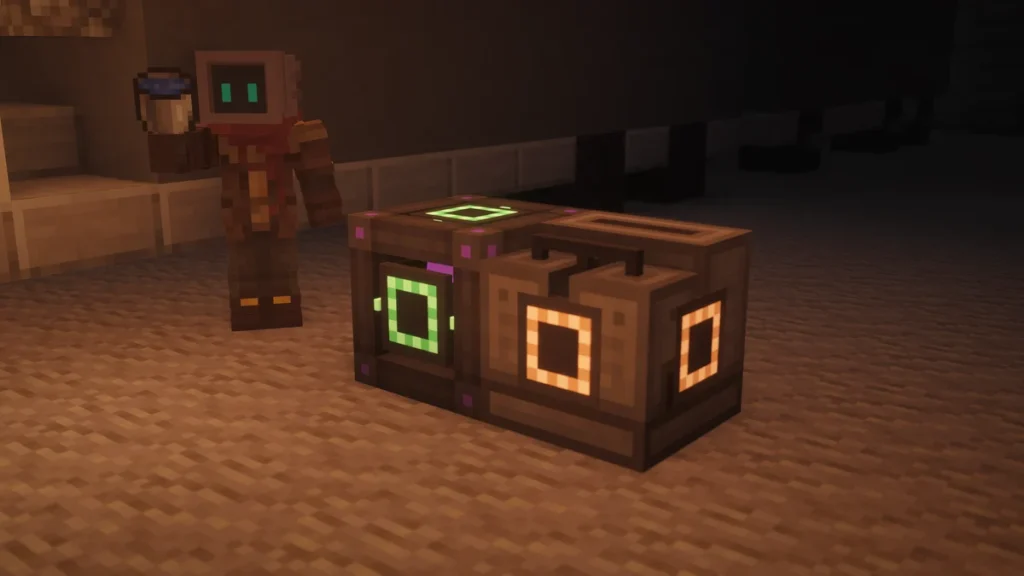
The  Electrolytic Separator is a Mekanism machine that splits a fluid into two chemicals, and the one you’ll use it for first is turning Water into Hydrogen and Oxygen. It’s also able to split Brine into Sodium and Chlorine, and Heavy Water into Deuterium and Oxygen, so it sits at the start of most of the mod’s chemical lines.
To get Hydrogen you’ll want to place the machine, give it power and pipe Water into it, which makes 2 mB of Hydrogen and 1 mB of Oxygen every tick. Each of those ticks costs 160 FE (400 J), and that works out at 80 FE for every mB of Hydrogen, which is exactly what the Hydrogen gives back when it’s burned.
How to Make It
You’ll need an  Electrolytic Core for the middle of the recipe, with an
 Infused Alloy on either side of it. The top and bottom rows are both an
 Iron Ingot, a
 Redstone Dust and another Iron Ingot, so the whole machine is cheap once the core is made.


The Electrolytic Core is the part that takes some work, as it’s crafted from 5 Infused Alloy, 2  Osmium Dust, an
 Iron Dust and a
 Gold Dust. Those dusts come from the
 Enrichment Chamber or the
 Crusher, and the alloy comes from the
 Metallurgic Infuser, so you’ll be able to build one fairly early on.
How It Works
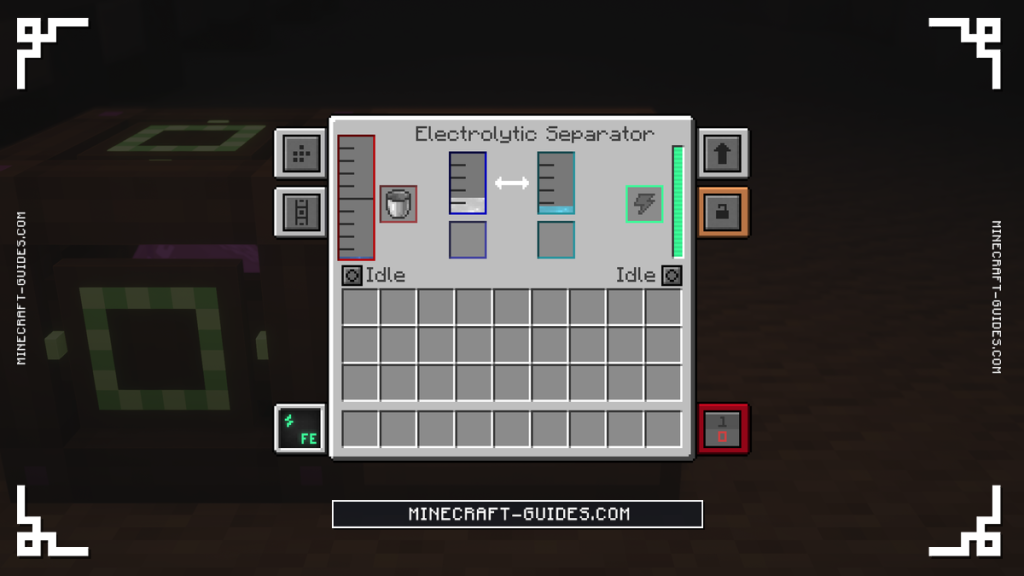
The Electrolytic Separator has one fluid tank that holds 24 buckets, and two output tanks that hold 2,400 mB each. Water can be piped in from an  Electric Pump, or you’re able to drop a
 Water Bucket into the slot beside the tank, which will empty it for you.
The machine will stop as soon as one of its output tanks fills up, even if the other one is empty. If you only want the Hydrogen, the Oxygen will fill its tank in about 2 minutes and everything stops, so you’ll need to set that side to dump or pipe it away.
It’ll hold 64,000 FE and it does one operation every tick while it has a fluid and room in both output tanks. The left tank takes the first chemical of the recipe and the right tank takes the second, so for Water that’s Hydrogen on the left and Oxygen on the right.
Dump settings
There’s a small button under each output tank, which cycles that tank through three modes. Idle keeps everything, Dumping Excess will throw away whatever is above 85% of the tank, and Dumping destroys what’s in the tank a little each tick, which gets faster with  Speed Upgrades.
For a chemical you don’t want at all, Dumping is the one to pick, as the tank will never fill. Dumping Excess is used for a chemical you do want to keep a buffer of, but it’s worth knowing that the machine will stop if both tanks are set to it and both have reached 85%. On 1.20.1 that mode kept 90% of the tank instead.
Getting the chemicals out
Both chemicals are pushed out by the machine itself, with the left tank leaving through the left side and the right tank through the right, as you face the front. So a Pressurized Tube on each of those sides is all it takes, and the  Configurator page shows how to move them to a different face.
Recipes
There are only three recipes, and the amounts below are for one operation, which is one tick with no upgrades. The left and right columns are the two output tanks as you’ll see them in the machine’s screen.
| Fluid In | Left Tank | Right Tank | Energy |
|---|---|---|---|
| 2 mB Water | 2 mB Hydrogen | 1 mB Oxygen | 160 FE |
| 10 mB Brine | 1 mB Sodium | 1 mB Chlorine | 160 FE |
| 2 mB Heavy Water | 2 mB Deuterium | 1 mB Oxygen | 320 FE |
Heavy Water costs double the energy of the other two, so it’s 320 FE for each operation rather than 160 FE. None of the three need anything else in the machine, as there’s no item or second fluid involved.
Water to Hydrogen and Oxygen
This is the recipe that feeds everything else. Hydrogen goes into the  Pressurized Reaction Chamber to make Ethene (called Ethylene in older versions), and into a
 Chemical Infuser with Chlorine to make Hydrogen Chloride. Oxygen is used by the
 Purification Chamber for tripling ores, and for Sulfur Trioxide.
It’s tempting to burn the Hydrogen in a  Gas-Burning Generator, but you’ll only get back the 80 FE per mB that was spent to make it. So a separator running into a generator makes no power at all, whereas the same Hydrogen turned into Ethene is worth 11,280 FE per mB.
Brine to Sodium and Chlorine
Brine comes from a Thermal Evaporation Plant, which makes 1 mB of it from 10 mB of Water. The separator then needs 10 mB of Brine for 1 mB each of Sodium and Chlorine, so it’s 100 mB of Water for every mB of Chlorine. Sodium is the second coolant for the Fission Reactor, and it’ll want dumping until you’ve built one.
Heavy Water to Deuterium
Heavy Water is pumped by an Electric Pump with a  Filter Upgrade, and it’s only used here. The Deuterium it makes is one half of the D-T Fuel for the Fusion Reactor, and this recipe only exists when Mekanism Generators is installed, which it will be in almost every pack.
Filling a Jetpack or Scuba Tank
Under each output tank there’s an item slot, and anything placed in it will be filled from that tank. So you’ll put a  Jetpack or a
 Flamethrower in the left slot to fill it with Hydrogen, and a
 Scuba Tank in the right slot for Oxygen.
Right-clicking the machine or a tank with the item in your hand does nothing, as it has to go in the slot. A Chemical Tank has the same kind of slot, which is handy if you’d like to keep a tank of Hydrogen by your door instead of walking back to the separator.
Upgrades and Automation
The Electrolytic Separator takes Speed, Energy and  Muffling Upgrades, and Speed Upgrades work differently here than on an item machine. Each one doubles the operations per tick, so 8 of them give 256 operations, which is 512 mB of Hydrogen a tick for 40,960 FE/t.
 Energy Upgrades won’t lower what an operation costs on this machine, as the 160 FE is fixed, and they’ll only make its energy buffer bigger. So there’s no cheaper way to make Hydrogen than the base rate, and the Machine Upgrades page has what each upgrade does on the other machines.
| Speed Upgrades | Hydrogen | Oxygen | Water Used | Energy |
|---|---|---|---|---|
| 0 | 2 mB/t | 1 mB/t | 2 mB/t | 160 FE/t |
| 2 | 8 mB/t | 4 mB/t | 8 mB/t | 640 FE/t |
| 4 | 32 mB/t | 16 mB/t | 32 mB/t | 2,560 FE/t |
| 6 | 128 mB/t | 64 mB/t | 128 mB/t | 10,240 FE/t |
| 8 | 512 mB/t | 256 mB/t | 512 mB/t | 40,960 FE/t |
One Electric Pump with no upgrades gives about 52 mB of Water a tick, which is plenty for a separator with 4 Speed Upgrades. From here the Hydrogen and Chlorine usually go straight into a Chemical Infuser, which is the next machine you’ll want for Hydrogen Chloride.
FAQ
Hydrogen is made by an Electrolytic Separator from Water, at 2 mB a tick for 160 FE/t with no upgrades. You’ll want an Electric Pump over a Water source to feed it, and the Oxygen side set to Dumping if you aren’t using it, as a full tank will stop the machine.
It’ll stop when either output tank is full, so check the tank you aren’t using, which is usually Oxygen. Set that tank to Dumping with the button under it, or pipe it away. It also needs 160 FE for every operation, so it might just be short of power.
Hydrogen burns for 80 FE per mB, and it costs 80 FE per mB to make, so the loop only breaks even before any losses. It’s better to turn the Hydrogen into Ethene in a Pressurized Reaction Chamber, as that burns for 11,280 FE per mB instead.
Put the Jetpack in the item slot under the Hydrogen tank of an Electrolytic Separator, or in the slot of a Chemical Tank that holds Hydrogen. It’ll fill by itself from there, and right-clicking a tank with it won’t work.


