
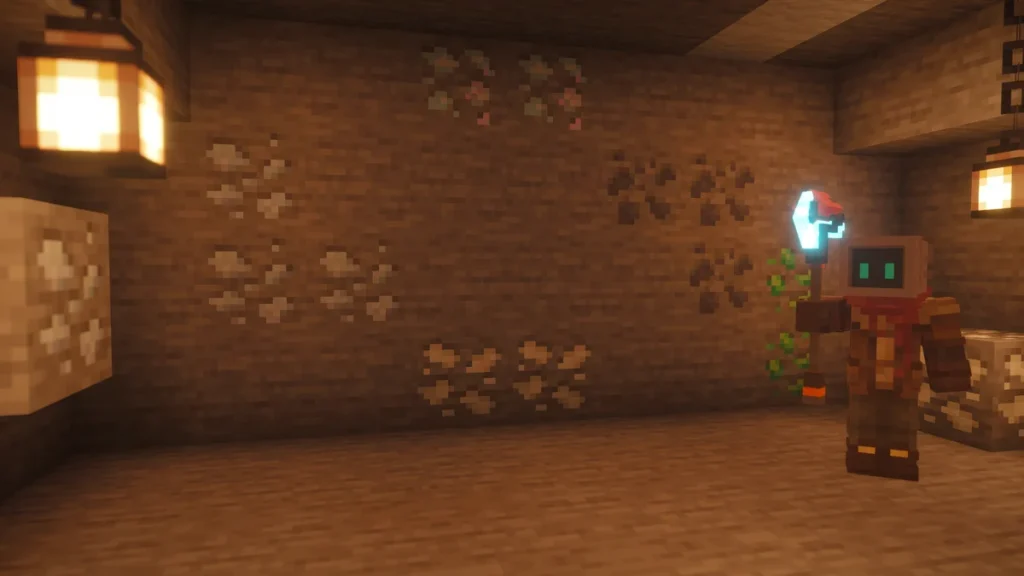
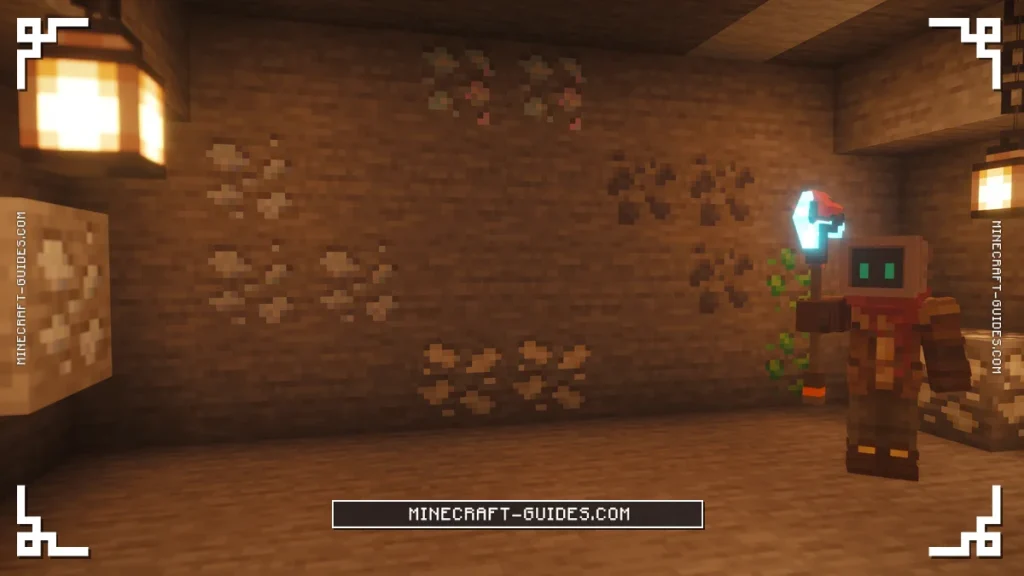
Mekanism adds five ores to the Overworld, which are Osmium, Tin,  Lead, Uranium and Fluorite, and you won’t find any of them in the Nether or the End. Osmium is the one you’ll need first, as there’s an Osmium Ingot in the recipe for the
 Metallurgic Infuser and in most of the machines after it.
You’ll find Osmium at nearly any height, though there’s a lot more of it inside mountains above Y 72. Tin is fairly shallow, Lead sits a little below sea level, and both Uranium and Fluorite are deep ores, which you’ll have to dig for near the bottom of the world.
How to Get It
All of the ores need a  Stone Pickaxe or better to mine, and each one has a
 Deepslate version that’ll show up wherever the vein runs into Deepslate. The four metals drop a single raw ore, like
 Raw Osmium, and Fortune works on them in the same way as it does on
 Iron Ore.
| Ore | Y Levels | Drops |
|---|---|---|
| Osmium Ore | Y 72 and up, Y -32 to 56, Y -64 to 64 | 1 Raw Osmium |
| Tin Ore | Y -20 to 94, Y -32 to 72 | 1 Raw Tin |
| Lead Ore | Y -64 to 64 | 1 Raw Lead |
| Uranium Ore | Y -64 to 8 | 1 Raw Uranium |
| Fluorite Ore | Y -64 to 23 | 2 to 4 Fluorite |
The veins are more common near the middle of each range and get rarer at the ends, apart from the lowest Osmium band and the smaller Fluorite veins, which are spread out evenly. These are the default numbers, and a server is able to change them or switch an ore off, which is on the Config and Mod Compatibility page.
Osmium
 Osmium Ore generates in three separate bands, and the biggest of them starts at Y 72 and carries on up past the build limit. It only shows up where there’s stone that high, so it’s worth mining into the side of a mountain, as you’ll run into a lot more of it there than you would underground.

In flatter areas, your Osmium will come from the other two bands, with one of them running from Y -32 to 56 and a smaller one that’s spread evenly from the bottom of the world up to Y 64. So you’ll usually pick some up while you’re mining for Iron, as they’re found at the same sort of depth.
Tin and Lead
 Tin Ore is a shallow ore, and you should see the most of it somewhere around Y 20 to Y 40, in caves that aren’t far below the surface.
 Lead Ore is found from Y 64 down to the bottom of the world and should be most common a little below Y 0, though a quarter of the blocks that would be touching air are removed.
Uranium and Fluorite
 Uranium Ore only generates below Y 8, and most of it is buried, as the larger veins have three quarters of the blocks that would be exposed in a cave removed. That means you won’t see much of it on cave walls, so you’ll want to strip mine for it down in the Deepslate.
 Fluorite Ore is found below Y 23, and it’s the only one that works like a gem ore. It’ll drop between 2 and 4
 Fluorite along with some experience, and the bigger veins never touch air at all, so they’ll only turn up while you’re digging.
Salt
 Salt Blocks aren’t an ore, as they generate in small patches under water, where they take the place of
 Dirt and
 Clay on the bottom. Breaking one will drop 4
 Salt, and four Salt can be crafted back into a block. You’ll also be able to make Salt later on, by putting Gaseous Brine through a
 Chemical Crystallizer.
How to Use It
Smelting and Doubling
Any of the raw ores can be smelted in a  Furnace or a
 Blast Furnace for one ingot, which is all you’ll need to get started. Once you’ve built an Enrichment Chamber, it’ll turn an ore block into two dust, and each dust smelts into an ingot. Raw ore isn’t quite doubled though, as it takes three of them to make four dust.


So you’ll get the most out of the  Enrichment Chamber by mining with Silk Touch, or by turning nine raw ore into a block like the
 Block of Raw Osmium, which gives twelve dust. The machines after that are able to get up to five ingots from each ore, and they’re all on the Ore Processing page.
What Each One Is For
An  Osmium Ingot goes into nearly everything, so it’s the one to stockpile, and it’s also used up by the
 Osmium Compressor, at one ingot for each item.
 Tin Ingots are mostly for Bronze and a few bits of gear, like the
 Jetpack.
| Resource | Main Uses |
|---|---|
| Osmium Ingot | Metallurgic Infuser, Steel Casing, Basic Control Circuit, generators, Osmium Compressor fuel |
| Tin Ingot | Bronze, Jetpack, Canteen, Resistive Heater, Module Base |
| Lead Ingot | Hazmat Suit, Fission Reactor Casing, Reactor Glass, Radioactive Waste Barrel, QIO Drives |
| Uranium Ingot | Yellow Cake Uranium, which becomes Fissile Fuel |
| Fluorite | Hydrofluoric Acid for Fissile Fuel, Chemical Crystallizer |
| Salt | Hydrogen Chloride for the Chemical Injection Chamber |
 Lead Ingots aren’t needed until you start on anything radioactive, as they go into the Hazmat Suit and the casing for a Fission Reactor. The
 Uranium Ingot is for the same part of the mod, as an Enrichment Chamber will turn one into two
 Yellow Cake Uranium, which is the start of Fissile Fuel.
Storage Blocks and Nuggets
Nine ingots will craft into a storage block, like the  Block of Osmium, and nine nuggets make an ingot, so they work just like the vanilla metals. The four metal blocks can also be used in the base of a
 Beacon, and Fluorite has a
 Block of Fluorite of its own, crafted from nine gems.
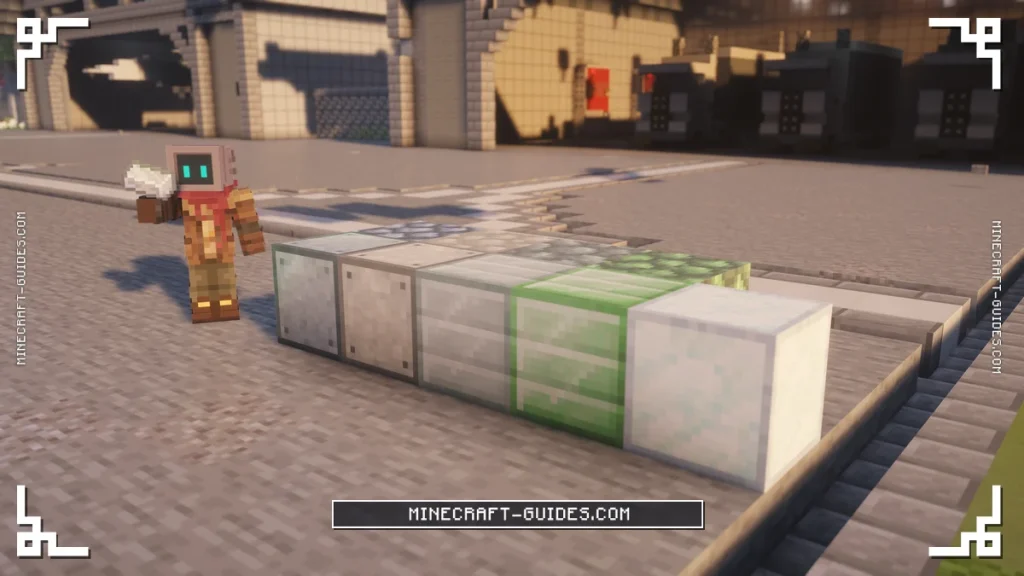
If you’ve mined some ore with Silk Touch, or you’d like to move it around as blocks, the nuggets and raw blocks all craft back the other way as well. Once you’ve got a few Osmium Ingots, the next thing to build with them is the Metallurgic Infuser.
FAQ
Osmium Ore generates in the Overworld at almost any height, and it’s found in three bands. The biggest one is above Y 72, so you’ll see the most of it inside mountains, and the other two run from Y -32 to 56 and from the bottom of the world up to Y 64. You’ll need a Stone Pickaxe to mine it.
Uranium Ore is only found below Y 8, all the way down to the bottom of the world. Most of the veins are buried inside the stone as well, as the ones that would be exposed in caves are mostly removed, so it’s better to strip mine for it in the Deepslate than to look around in caves.
Fluorite is mainly used to make Hydrofluoric Acid, which is one of the steps in turning Uranium into Fissile Fuel for a Fission Reactor. It’s also in the recipe for the Chemical Crystallizer, and  Fluorite Dust is needed later on to make Plutonium and
 Polonium Pellets, so you won’t need any of it early.
All five ores only generate in the Overworld, so you won’t come across them in the Nether or the End. They do generate in every Overworld biome though, and a modpack is able to change the heights and amounts, or turn an ore off, in the mod’s world config file.


