

The  Chemical Infuser is a Mekanism machine that’s used to combine 2 chemicals into a new one, and it’s how you’ll make Hydrogen Chloride and Sulfuric Acid for ore processing. It has 5 recipes in total, and each mB that it makes costs 80 FE (200 J), with no items going in or out at any point.
You’ll need at least one of these for the 4x ore tier and 2 more for 5x, as Sulfuric Acid takes 2 steps in it. Later on it’s used for Uranium Hexafluoride on the way to Fissile Fuel, as well as the D-T Fuel that a Fusion Reactor burns.
How to Make It
It’s one of the cheaper chemical machines, needing 4  Infused Alloy, 2
 Basic Control Circuits, 2
 Basic Chemical Tanks and a
 Steel Casing. The casing goes in the middle with a tank on each side of it, and the circuits go above and below with the alloy in the corners.


Nothing in the recipe is past the first tier of alloys and circuits, so you’re able to build it long before the machines that use what it makes. It’s worth crafting 3 at once if you’re heading for 5x, as they can’t be switched between recipes without emptying them first.
How It Works
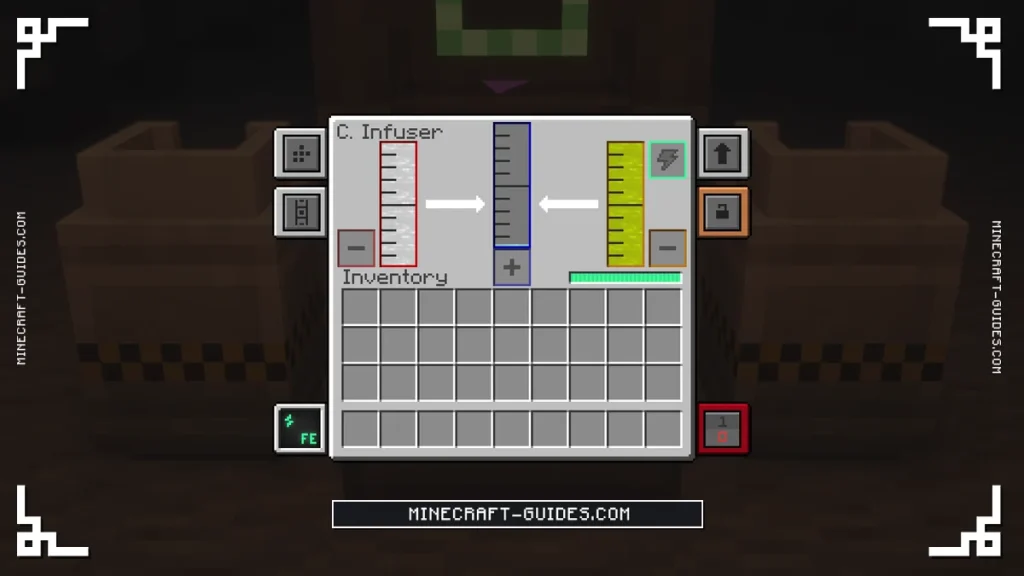
The Chemical Infuser has 3 tanks that each hold 10,000 mB, with an input tank on the left and right and the output in the middle. It doesn’t matter which chemical goes into which side, as either tank will take either one, and it starts working as soon as both have something in them and there’s power.

It runs one recipe every tick rather than taking a few seconds for each one, so it’s measured in mB per tick. Without upgrades that’s 1 mB of Hydrogen Chloride or Sulfuric Acid each tick for 80 FE/t, which is about what a single  Chemical Injection Chamber or
 Chemical Dissolution Chamber will use while it’s working.
The output tank pushes into a tube or tank on the front of the machine by itself, and the left and right sides each feed the input tank on that side. The 2 input tanks can never be piped out, so if the wrong chemical gets in, it has to be removed by hand with a  Gauge Dropper.
Recipes
These are all of the recipes, with the amounts used and made for each one. The ratios matter when you’re sizing a setup, as Sulfur Trioxide uses half as much Oxygen as it does Sulfur Dioxide, and 2 of the recipes give back double.
| Input 1 | Input 2 | Output |
|---|---|---|
| 1 mB Hydrogen | 1 mB Chlorine | 1 mB Hydrogen Chloride |
| 1 mB Oxygen | 2 mB Sulfur Dioxide | 2 mB Sulfur Trioxide |
| 1 mB Sulfur Trioxide | 1 mB Water Vapor | 1 mB Sulfuric Acid |
| 1 mB Hydrofluoric Acid | 1 mB Uranium Oxide | 2 mB Uranium Hexafluoride |
| 1 mB Deuterium | 1 mB Tritium | 2 mB D-T Fuel |
The machine works out which recipe to run from what’s in the 2 input tanks, so there’s nothing to set. If only one of the tanks has anything in it, or the 2 chemicals don’t go together, it’ll just sit there and wait without using any power.
Hydrogen Chloride
Hydrogen Chloride is the first one most players will set up, as it’s what the Chemical Injection Chamber runs on. The Hydrogen and the Chlorine both come from an  Electrolytic Separator, with one splitting Water and a second one splitting Brine from a Thermal Evaporation Plant.
Sulfuric Acid
Sulfuric Acid needs 2 Chemical Infusers in a row. The first one takes Sulfur Dioxide from a  Chemical Oxidizer and combines it with Oxygen to make Sulfur Trioxide, and the second one adds Water Vapor to that, which you’ll get by running Water through a
 Rotary Condensentrator.
One  Sulfur Dust gives 100 mB of Sulfur Dioxide, and with 50 mB of Oxygen and 100 mB of Water Vapor it’ll end up as 100 mB of Sulfuric Acid. That’s enough to dissolve one ore block in a Chemical Dissolution Chamber, so the acid line needs roughly 1 Sulfur Dust for each ore.
Uranium Hexafluoride and D-T Fuel
The last 2 recipes are for power. Uranium Hexafluoride is one step away from Fissile Fuel, which is finished in an  Isotopic Centrifuge, and D-T Fuel is what’s injected into a Fusion Reactor. Both of them give 2 mB for every 1 mB of each input, and the D-T Fuel recipe is added by Mekanism Generators.
Upgrades and Automation
It takes Speed, Energy and Muffling upgrades. Each  Speed Upgrade doubles the number of recipes it runs every tick, so 1 upgrade makes 2 mB a tick, 4 make 16 mB and all 8 make up to 256 mB, as long as the tanks and the power are able to keep up.
The energy for each mB goes up with Speed Upgrades as well, by a little under double for each one, which is why  Energy Upgrades are worth adding alongside them. A second Chemical Infuser will often be cheaper to run than a heavily upgraded one, as it’ll make the same amount at 80 FE for each mB.
For automation you’ll want a Pressurized Tube for each input and a third one for the output, and it’s best to keep the 2 inputs on separate tube networks so they don’t mix. Chemicals can be stored in a Chemical Tank between machines if one side is faster than the other. The Chemical Oxidizer is the machine that feeds it Sulfur Dioxide and Uranium Oxide.
FAQ
The input tanks can’t be piped out, so they’re emptied with a Gauge Dropper. Open the machine, pick the Gauge Dropper up so it’s on your cursor, then hold Shift and left-click the tank you’d like to clear, which will delete everything in it. A plain left-click will fill the  Dropper instead, if you only need to take a little out.
Sulfuric Acid is made in a Chemical Infuser from Sulfur Trioxide and Water Vapor, at 1 mB of each for 1 mB of acid. The Sulfur Trioxide comes from a second Chemical Infuser, which combines Sulfur Dioxide with Oxygen. Sulfur Dioxide is made by putting Sulfur Dust into a Chemical Oxidizer, and the Water Vapor comes from a Rotary Condensentrator.
Hydrogen Chloride takes 1 mB of Hydrogen and 1 mB of Chlorine in a Chemical Infuser. Both of them are made in an Electrolytic Separator, with Hydrogen coming from Water and Chlorine coming from Brine. The Brine is the slow part, as it has to be made in a Thermal Evaporation Plant first.
It runs one recipe every tick, which is 20 mB of Hydrogen Chloride or Sulfuric Acid each second, so a full bucket takes 50 seconds. Each Speed Upgrade doubles that, which means 4 of them will make 16 mB a tick. The recipes that give 2 mB, like Sulfur Trioxide, are twice as fast as well.


