
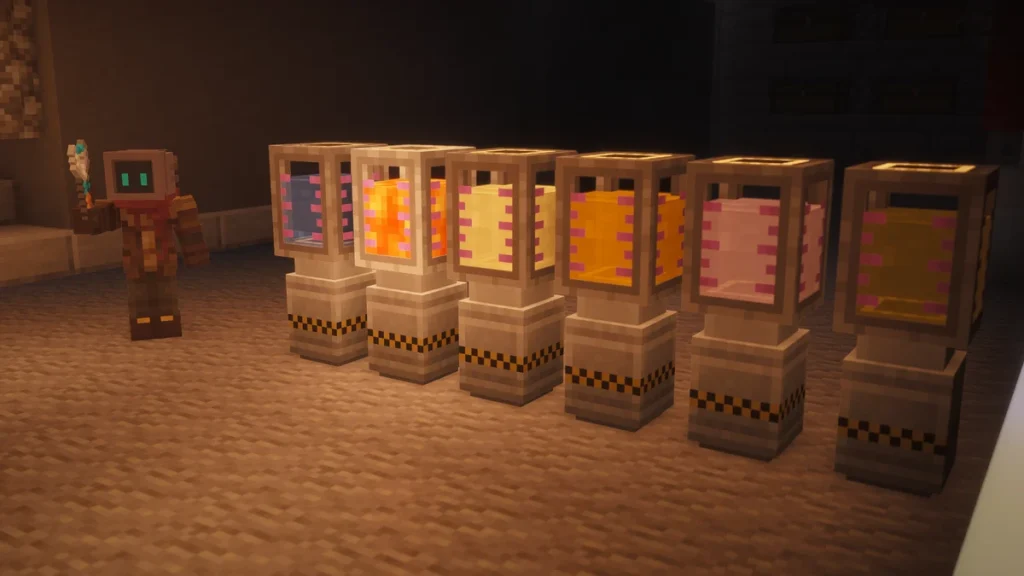

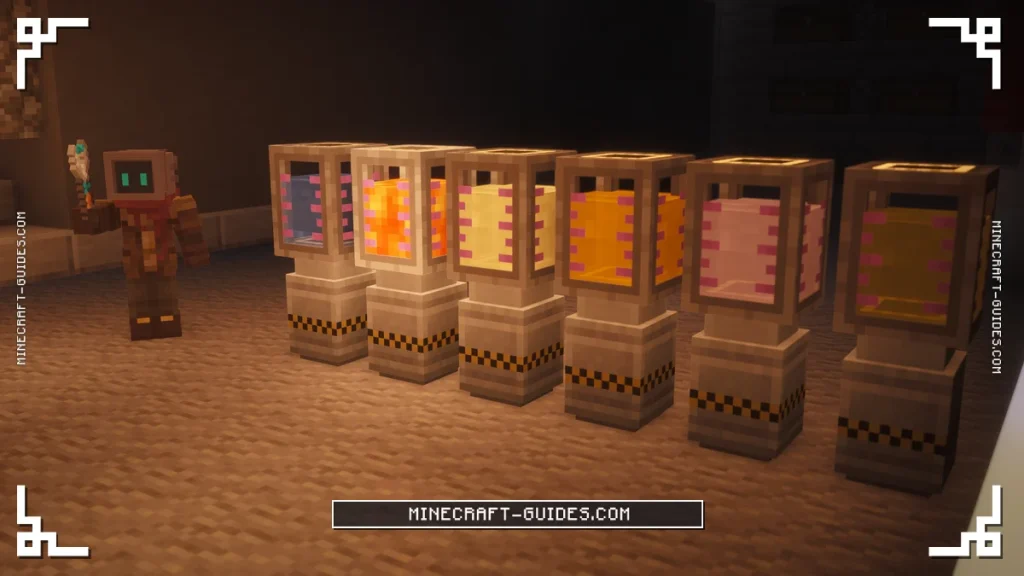
Mekanism’s chemicals are what used to be called gases, and they’re the things its machines pass between each other, like Hydrogen, Oxygen and Sulfuric Acid. On current versions the infusing materials, pigments and ore slurries are chemicals as well, so they all travel in Pressurized Tubes and they’re all stored in Chemical Tanks.
Most of them have a fluid form too, with Liquid in front of the name, which moves in Mechanical Pipes and sits in a Fluid Tank instead. This page lists every chemical and fluid with what makes it and what uses it, and then goes through the chains that need more than one machine.
Every Chemical and Fluid
The table below has every chemical and fluid that’s added by Mekanism and Mekanism Generators. You’re able to search it for a name, or filter it down to just the fuels or the radioactive ones, and the fuel value is what 1 mB of it will give you in a  Gas-Burning Generator.
Every Mekanism Chemical and Fluid
| Hydrogen | Chemical and fluid | Electrolytic Separator from Water | Ethene, Hydrogen Chloride, Gas-Burning Generator, Jetpack, Flamethrower | 80 | No |
|---|---|---|---|---|---|
| Oxygen | Chemical and fluid | Electrolytic Separator from Water or Heavy Water; 10 mB from a Flint | Purification Chamber, Sulfur Trioxide, coal gasification, HDPE Pellet, Scuba Tank | — | No |
| Water Vapor | Chemical and fluid | Rotary Condensentrator from Water | Sulfuric Acid; mud, clay and concrete recipes in the Chemical Injection Chamber | — | No |
| Steam | Chemical and fluid | Thermoelectric Boiler, water-cooled Fission Reactor or Fusion Reactor | Industrial Turbine | — | No |
| Chlorine | Chemical and fluid | Electrolytic Separator from Brine | Hydrogen Chloride | — | No |
| Sodium | Chemical and fluid | Electrolytic Separator from Brine | Fission Reactor coolant | — | No |
| Superheated Sodium | Chemical and fluid | Sodium heated in a Fission Reactor | Thermoelectric Boiler, which cools it back to Sodium | — | No |
| Brine (Gaseous Brine) | Chemical and fluid | Thermal Evaporation Plant, 10 Water to 1; or 15 mB from Salt in a Chemical Oxidizer | Liquid Lithium, Sodium and Chlorine, Salt | — | No |
| Lithium | Chemical and fluid | Thermal Evaporation Plant, 10 Brine to 1 Liquid Lithium | Tritium, Lithium Dust | — | No |
| Sulfur Dioxide | Chemical and fluid | Chemical Oxidizer, 100 mB from a Sulfur Dust | Sulfur Trioxide | — | No |
| Sulfur Trioxide | Chemical and fluid | Chemical Infuser from Oxygen and Sulfur Dioxide | Sulfuric Acid | — | No |
| Sulfuric Acid | Chemical and fluid | Chemical Infuser from Sulfur Trioxide and Water Vapor | Chemical Dissolution Chamber for ore slurry and Hydrofluoric Acid | — | No |
| Hydrogen Chloride | Chemical and fluid | Chemical Infuser from Hydrogen and Chlorine | Chemical Injection Chamber for ores, Sulfur Dust and reprocessing Plutonium Pellets | — | No |
| Hydrofluoric Acid | Chemical and fluid | Chemical Dissolution Chamber, 1,000 mB from a Fluorite | Uranium Hexafluoride | — | No |
| Uranium Oxide | Chemical and fluid | Chemical Oxidizer, 250 mB from a Yellow Cake Uranium | Uranium Hexafluoride | — | No |
| Uranium Hexafluoride | Chemical and fluid | Chemical Infuser from Hydrofluoric Acid and Uranium Oxide | Fissile Fuel | — | No |
| Fissile Fuel | Chemical only | Isotopic Centrifuge from Uranium Hexafluoride | Fission Reactor | — | No |
| Nuclear Waste | Chemical only | Fission Reactor, 1 mB for each mB of fuel burned | Plutonium, Polonium | — | Yes |
| Plutonium | Chemical only | Isotopic Centrifuge, 10 Nuclear Waste to 1 | Plutonium Pellet | — | Yes |
| Polonium | Chemical only | Solar Neutron Activator, 10 Nuclear Waste to 1 | Polonium Pellet, Antimatter | — | Yes |
| Spent Nuclear Waste | Chemical only | Left over from making Plutonium Pellets and Polonium Pellets | Nothing, it goes in a Radioactive Waste Barrel | — | Yes |
| Antimatter | Chemical only | Supercritical Phase Shifter, 1,000 Polonium to 1 | Antimatter Pellet, Antiprotonic Nucleosynthesizer | — | No |
| Ethene | Chemical and fluid | Pressurized Reaction Chamber from Bio Fuel, Water and Hydrogen | Gas-Burning Generator, HDPE Pellet, Substrate | 11280 | No |
| Deuterium | Chemical and fluid | Electrolytic Separator from Heavy Water | D-T Fuel, Fusion Reactor | — | No |
| Tritium | Chemical and fluid | Solar Neutron Activator from Lithium | D-T Fuel, Fusion Reactor | — | No |
| D-T Fuel | Chemical and fluid | Chemical Infuser from Deuterium and Tritium | Fusion Reactor, Hohlraum | — | No |
| Osmium | Chemical only | 200 mB from an Osmium Ingot in a chemical slot | Osmium Compressor | — | No |
| Carbon | Chemical only | Coal 10 mB, Charcoal 20 mB, Enriched Carbon 80 mB | Enriched Iron and Steel Dust | — | No |
| Redstone | Chemical only | Redstone Dust 10 mB, Enriched Redstone 80 mB | Infused Alloy, Control Circuits | — | No |
| Diamond | Chemical only | Diamond Dust 10 mB, Enriched Diamond 80 mB | Reinforced Alloy, Elite Control Circuit, Refined Obsidian Dust | — | No |
| Refined Obsidian | Chemical only | Refined Obsidian Dust 10 mB, Enriched Obsidian 80 mB | Atomic Alloy, Ultimate Control Circuit | — | No |
| Gold | Chemical only | Gold Dust 10 mB, Enriched Gold 80 mB | Netherite Dust, Gilded Blackstone | — | No |
| Tin | Chemical only | Tin Dust 10 mB, Enriched Tin 80 mB | Bronze | — | No |
| Biomass | Chemical only | Bio Fuel, 5 mB each | Slime Balls, Dirt, Podzol and mossy blocks | — | No |
| Fungi | Chemical only | Any mushroom or fungus, 10 mB each | Mycelium, Crimson Nylium, Warped Nylium | — | No |
| Pigments (18 colors) | Chemical only | Pigment Extractor, Pigment Mixer | Painting Machine | — | No |
| Dirty Slurry (7 metals) | Chemical only | Chemical Dissolution Chamber from ore and Sulfuric Acid | Chemical Washer | — | No |
| Clean Slurry (7 metals) | Chemical only | Chemical Washer from Dirty Slurry and Water | Chemical Crystallizer, 200 mB for a Crystal | — | No |
| Heavy Water | Fluid only | Electric Pump with a Filter Upgrade | Deuterium | — | No |
| Nutritional Paste | Fluid only | Nutritional Liquifier from any food | Canteen, MekaSuit Nutritional Injection Unit | — | No |
| Bioethanol | Fluid only | Made inside the Bio-Generator from Bio Fuel | Bio-Generator | — | No |
No chemicals and fluids match those filters.
Amounts are at default config. The fluid form of a chemical is named Liquid, like Liquid Hydrogen, except that Gaseous Brine becomes Brine and Water Vapor becomes Water.
Only Hydrogen and Ethene (called Ethylene in older versions) burn, and Ethene is worth 141 times as much, at 11,280 FE (28,200 J) for each mB. Sodium is the only coolant besides Water, and the four radioactive ones all come from the Fission Reactor, so they’re covered on the Nuclear Waste page.
Chemicals, Fluids and Buckets
A chemical and its fluid form are two different things as far as the machines are concerned, and a recipe will only ever take the one that it asks for. The  Rotary Condensentrator is used to swap between them at 1 mB for 1 mB, and you’ll need it for jobs like Liquid Ethene for HDPE and Water Vapor for Sulfuric Acid.
Buckets
The fluid forms can be picked up in buckets, like the  Liquid Sulfuric Acid Bucket, the
 Liquid Oxygen Bucket or the
 Liquid Chlorine Bucket. There isn’t a recipe for any of them, as they’re filled from a tank that’s holding at least a bucket of the fluid, and they’re really only there for carrying a little of it by hand.
The same goes for the  Liquid Sulfur Dioxide Bucket, the
 Liquid Sulfur Trioxide Bucket, the
 Liquid Hydrogen Chloride Bucket, the
 Liquid Sodium Bucket and the
 Liquid Superheated Sodium Bucket. You probably won’t see most of these unless you go looking for them, as the lines that use them all run on the chemical form instead.
Storing and dumping
Any chemical that isn’t radioactive will go into a Chemical Tank of any tier, or into a Dynamic Tank if you need a lot of it. A tank only ever holds one chemical at a time, so each one you’re keeping needs its own.
Nuclear Waste, Spent Nuclear Waste, Plutonium and Polonium can’t be put in a Chemical Tank or a  Dynamic Tank. They’ll only sit in the machines that use them, in Pressurized Tubes, or in a
 Radioactive Waste Barrel, and breaking any of those lets the radiation out.
Everything else is safe to store, and nothing will happen if you break a tank that’s holding it. If a tank is filling up with something that you don’t need, then a Chemical Tank and the  Electrolytic Separator both have a dump button, which can be set to destroy what’s coming in rather than letting it back up.
Hydrogen and Oxygen
Both of these come from Water in an Electrolytic Separator, which will give you twice as much Hydrogen as Oxygen. It costs 80 FE to make each mB of Hydrogen, which is exactly what it gives back when it’s burned, so it’s only worth making for what it can be turned into, like Ethene.
Oxygen is what the  Purification Chamber uses to triple ores, at about 200 mB for each item. If you only need a little, a
 Flint placed in the machine’s chemical slot is worth 10 mB of Oxygen, though that’s far too slow for a real ore line.
Sulfuric Acid
Sulfuric Acid is the one that takes the most machines, and it’s needed for the last tier of Ore Processing and for reactor fuel. It all starts with  Sulfur Dust, and each dust ends up as 100 mB of acid.
Getting Sulfur Dust
There are two machines that make the dust, and neither of them is a crafting recipe. Both need a chemical as well as an item, so they’re each a small line of their own.


The viewer only shows the item going in, so here’s the rest of it. In a  Pressurized Reaction Chamber, 1
 Coal or
 Charcoal with 100 mB of Water and 100 mB of Oxygen gives 1 Sulfur Dust and 100 mB of Hydrogen. The other way is
 Gunpowder with Hydrogen Chloride in a
 Chemical Injection Chamber, which is the slower route.
From dust to acid
After that it’s four steps, and the amounts in the table are for a single Sulfur Dust. The Oxygen in step 2 is the same Oxygen the separator makes alongside its Hydrogen, so nothing extra is needed for it.
| Step | Machine | In | Out |
|---|---|---|---|
| 1 | Chemical Oxidizer | 1 Sulfur Dust | 100 mB Sulfur Dioxide |
| 2 | Chemical Infuser | 50 mB Oxygen + 100 mB Sulfur Dioxide | 100 mB Sulfur Trioxide |
| 3 | Rotary Condensentrator | 100 mB Water | 100 mB Water Vapor |
| 4 | Chemical Infuser | 100 mB Sulfur Trioxide + 100 mB Water Vapor | 100 mB Sulfuric Acid |
So the whole line is a  Chemical Oxidizer, two
 Chemical Infusers and a Rotary Condensentrator that’s been set to its second mode. A Chemical Dissolution Chamber will use about 100 mB of acid for each ore, which means that one Coal covers one ore when there are no upgrades in it.
You’re also able to drop Sulfur Dust straight into the chemical slot of the  Chemical Dissolution Chamber, but that will only give you 2 mB for each dust. It’s 50 times worse than the line above, so it’s really only there to test a setup with, before you’ve got the acid running properly.
Hydrogen Chloride
Hydrogen Chloride is used by the Chemical Injection Chamber for the 4x ore tier, and it’s a shorter chain than the acid. Chlorine comes from Brine in an Electrolytic Separator, and a Chemical Infuser then combines 1 mB of Hydrogen with 1 mB of Chlorine into 1 mB of Hydrogen Chloride.
The slow part is the Brine, as the Thermal Evaporation Plant needs 10 mB of Water for 1 mB of it, and the separator needs 10 mB of Brine for 1 mB of Chlorine. So every mB of Hydrogen Chloride is 100 mB of Water through the plant, and an ore uses about 200 mB of it.
 Salt can be used here as well, as one Salt in the chamber’s chemical slot is worth 2 mB of Hydrogen Chloride. You’d need about 90 Salt for a single ore if you did it that way though, which is why the plant tends to get built before anyone moves on to the 4x tier.
Chemicals Made From Items
Several chemicals never see a pipe, as they’re made by placing an item in a machine’s chemical slot. These are mostly the old infuse types for the  Metallurgic Infuser, and the amounts below are what one item is worth.
| Item | Chemical | Amount |
|---|---|---|
| Coal or Coal Dust | Carbon | 10 mB |
| Charcoal or Charcoal Dust | Carbon | 20 mB |
| Redstone Dust | Redstone | 10 mB |
| Diamond Dust, Gold Dust, Tin Dust, Refined Obsidian Dust | Diamond, Gold, Tin, Refined Obsidian | 10 mB |
| Any Enriched item | Its own chemical | 80 mB |
| Osmium Ingot | Osmium | 200 mB |
| Bio Fuel | Biomass | 5 mB |
| Any mushroom or fungus | Fungi | 10 mB |
| Flint | Oxygen | 10 mB |
| Salt | Hydrogen Chloride | 2 mB |
| Sulfur Dust | Sulfuric Acid | 2 mB |
The Enriched items are worth 8 times the dust they’re made from, which is why an  Enrichment Chamber pays for itself quickly. A Chemical Oxidizer makes the same amounts as a chemical you’re able to pipe, which is how a row of machines gets fed from one tank instead of by hand.
From here, the best page to read next is Ore Processing, as the ore tiers are what most of these chemicals get built for. It has how much of each one a full line will use, which is what decides the size of the plant.
FAQ
Turn Sulfur Dust into Sulfur Dioxide in a Chemical Oxidizer, combine it with Oxygen in a Chemical Infuser for Sulfur Trioxide, then combine that with Water Vapor in a second Chemical Infuser. One Sulfur Dust gives 100 mB of Sulfuric Acid, and the dust comes from Coal in a Pressurized Reaction Chamber.
Gases, infuse types, pigments and slurries were merged into one type called chemicals. The machines, tanks and tubes kept their names, and only the upgrade was renamed, to the  Chemical Upgrade, so old guides still mostly apply.
Use the dump button on the tank that holds it, which is on Chemical Tanks and on each output of the Electrolytic Separator. Dumping destroys what’s in the tank, whereas Dumping Excess only removes what’s above 85% of it, either of which stops a line backing up.
Only Nuclear Waste, Spent Nuclear Waste, Plutonium and Polonium are, and all four come from running a Fission Reactor. Fissile Fuel, Uranium Hexafluoride and Antimatter are safe to store in a Chemical Tank, like every other chemical.


