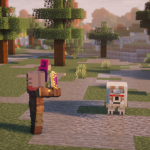
The Sulfur Cube is the headline mob of Minecraft’s Chaos Cubed drop, spawning exclusively in the new Sulfur Caves biome deep underground. This strange, blocky creature introduces physics-based gameplay unlike anything else in the game, absorbing blocks and completely transforming its movement behavior based on what it consumes.
What makes the Sulfur Cube in Minecraft so remarkable is its sheer versatility. Feed it  Ice and it glides like a hockey puck; feed it Wool and it floats like a beach ball; feed it
 TNT and things get explosive. Eleven distinct archetypes turn one mob into an entire physics playground.
The community response has been polarized. Minigame builders and Redstone engineers are constructing monorails, bowling alleys, and puzzle mechanisms, while survival-focused players question its practical value. Understanding how to find, capture, and utilize the Sulfur Cube unlocks creative possibilities that no other Minecraft entity can match.
Sulfur Cube
minecraft:sulfur_cubeWhere to Find Sulfur Cubes
Sulfur Cubes spawn naturally inside Sulfur Caves, a new underground biome introduced in the Chaos Cubed drop. These caves generate at low Y-levels and are less likely to appear under oceans, hills, or mountains, making flat overworld terrain the most reliable place to search for them.

Sulfur Caves are unmistakable once discovered. Bright yellow Sulfur Blocks, deep red Cinnabar formations, and pointed Sulfur Spikes line the walls and floors. The biome also features geothermal Sulfur Springs modeled after real-world formations, giving the caves a distinct volcanic personality.
Sulfur Cave Hazards
Pools of Potent Sulfur generate throughout the biome, and standing near them applies a noxious gas effect that causes Nausea. Bringing  Milk Buckets neutralizes this debuff quickly. Potent Sulfur only generates within water, so the pools are easy to spot and avoid while exploring.

Geysers erupt periodically throughout the caves, launching players and entities into the air with significant force. Each eruption emits vibrations at both the start and end, meaning nearby  Sculk Sensors can detect them. These Geysers add both danger and potential utility, as creative players can use the upward thrust for vertical transportation.
Sulfur Spikes and New Blocks
Sulfur Spikes are a decorative block found naturally in Sulfur Caves, and they can also be purchased from  Wandering Traders at a rate of 2 Sulfur Spikes for 1
 Emerald, with up to five trades available per trader. This provides a renewable source without repeated cave expeditions.
The Sulfur Caves biome also introduces Sulfur Blocks and Cinnabar Blocks with Chiseled variants. Community builders have already praised the Cinnabar color palette, and Cinnabar Bricks provide a warm red-toned block that fills a gap many builders have wanted for castle roofs and warm-toned structures.
How to Capture a Sulfur Cube
Capturing a Sulfur Cube works just like capturing an  Axolotl. Right-click the mob with an empty
 Bucket to scoop it up, creating a Sulfur Cube Bucket. This bucket can then be placed anywhere in the world, releasing the Sulfur Cube at the chosen location for experimentation or permanent installation.
Small vs. Large Variants

Sulfur Cubes come in both small and large variants. Small Sulfur Cubes have some restrictions:  Dispensers cannot equip blocks into them. Feeding a small Sulfur Cube a
 Slime Ball combined with a Golden Dandelion interacts with their aging timer, eventually allowing them to grow into full-sized versions.
Preventing Despawning
Wild Sulfur Cubes can despawn like other passive mobs. The most reliable way to keep one permanently is to apply a  Name Tag using an
 Anvil. Named Sulfur Cubes persist in the world even after being picked up in a bucket and placed back down, which was specifically patched in recent Snapshots.
All Sulfur Cube Archetypes Explained
The defining feature of the Sulfur Cube in Minecraft is block absorption. Feeding it any block changes its physics behavior into one of eleven archetypes, each with distinct bounce, friction, speed, and air drag values. Swapping archetypes is instant: feeding a new block replaces the current one, ejecting the old block in the process.
Rubber (Bouncy)
Golf
Hockey (Sliding)
Heavy
Bouncy and Airborne Archetypes
The Rubber archetype activates with Wood or Resin blocks, producing maximum bounce height. This turns the Sulfur Cube into a literal bouncy ball, ricocheting off walls and floors with satisfying energy. It is the go-to choice for vertical bounce games and testing how high a cube can fly.

Feeding the Sulfur Cube organic materials creates the Golf archetype, which bounces moderately but travels long distances with significant slide. Pairing this with  Soul Sand for putting is a popular strategy, since Soul Sand and
 Soul Soil make the cube nearly immovable, perfect for tapping into a final position.
Wool blocks of any color create the Light archetype, making the Sulfur Cube almost weightless. It floats through the air slowly and drifts gently, behaving like a beach ball. This archetype is ideal for volleyball-style rallies where keeping the cube airborne is the objective.
Sliding Archetypes
Ice and  Snow Blocks trigger the Fast Sliding archetype, eliminating all bounce while maximizing slide distance. The Sulfur Cube behaves exactly like a hockey puck, gliding across surfaces in a straight line. Building an ice rink and using a Hoe as a visual hockey stick sells the illusion perfectly.

Mushroom-based blocks produce the Slow Sliding archetype, causing gradual but continuous movement like a curling stone drifting down a lane. The slow, deliberate motion makes this archetype useful for precision-based games where controlled placement matters more than raw speed or distance.
Weight and Resistance Archetypes
Metal blocks including  Iron,
 Gold, and
 Copper create the Heavy archetype. These Sulfur Cubes barely budge when hit, mimicking a medicine ball. A creative use: line up several Heavy cubes as bowling pins and strike them with a Golf archetype ball for a surprisingly functional bowling lane.
Stone, Concrete, Brick, and Ore Blocks activate the Slow Bouncy archetype added in Snapshot 6. This combines slow speed with high bounciness and medium friction, creating a predictable, controlled bounce pattern.  Honeycomb Blocks create the Sticky archetype, which launches upward on impact but refuses to bounce or slide after landing, like a beanbag.
Any block not assigned to a specific category defaults to the Regular archetype with balanced football-style physics across all properties. Using  White Glazed Terracotta for this archetype even makes the cube resemble a soccer ball.
Dangerous Archetypes: TNT and Magma
TNT Sulfur Cubes are fully functional explosives. They respect the TNT Explodes and Mob Griefing game rules, but always test in a safe area first. Feeding a Sulfur Cube a TNT block unlocks the “Uh oh!” advancement.
Feeding a Sulfur Cube a TNT block creates a mobile explosive that can be launched across distances before detonating. TNT Sulfur Cubes are ignited using  Flint and Steel or Fire Aspect weapons, then hit to send them flying toward a target. Disabling the TNT Explodes game rule prevents detonation entirely and does not consume ignition items.
The Magma archetype, also added in Snapshot 6, uses  Magma Blocks. It behaves identically to the Regular archetype in terms of physics but damages any entity that touches it, exactly like stepping on a Magma Block. This is the only archetype that poses a direct contact threat, making it perfect for hazard-filled obstacle courses and competitive arenas.
Best Ways to Use the Sulfur Cube
While minigames are the most obvious application for the Sulfur Cube in Minecraft, the community has already pushed this mob far beyond simple sports. Its invincibility, passivity, and one-block height make it surprisingly versatile for survival engineering, building tricks, and transportation systems.
Soccer with Regular archetype, hockey on Ice with Fast Sliding, bowling using Heavy pins and Golf balls, curling with Slow Sliding, and volleyball with the Light archetype. Each sport works straight out of the box.
Honey Block monorails allow rideable transport with turns and jumps. Loyalty  Tridents thrown at Sulfur Cubes launch players significant distances. Both methods work in survival mode.
Apply Invisibility to hide the yellow frame, leaving only the absorbed block visible. This creates off-grid floating block displays impossible with normal placement, perfect for custom furniture and decorations.
Monorails and Transportation
Players discovered that placing a  Honey Block inside a Sulfur Cube creates a functional monorail system. The sticky physics combined with track designs allow rideable transportation complete with turns, jumps, and elevation changes. Designs differ between Java and Bedrock Editions, but both versions support working monorails in survival mode.
Tridents enchanted with Loyalty offer another transport trick. Throwing a Loyalty Trident at a Sulfur Cube and maintaining the interaction can launch players significant distances, sometimes gaining impressive airtime. While less reliable than a monorail, it provides a fun, chaotic travel option that requires minimal infrastructure.
Redstone and Puzzle Mechanics
The Sulfur Cube’s interaction with Pressure Plates and Tripwires enables Zelda-style puzzle rooms. Pushing a cube onto a Pressure Plate can open doors or activate pistons. Combining multiple cubes with different archetypes creates multi-step puzzles requiring players to switch physics modes mid-solve for increasingly complex contraptions.
As a passive, invincible, predictable entity, the Sulfur Cube fills a gap in Redstone engineering that previously required hostile mobs.  Creakings and
 Shulkers can serve similar purposes but behave unpredictably or pose danger. The Sulfur Cube stays exactly where placed and responds consistently to player input, making it the cleanest option for entity-based circuits and mechanisms.
Off-Grid Block Displays
Feeding a block to a Sulfur Cube and then applying an Invisibility Potion removes the yellow outline entirely, leaving only the absorbed block visible. This creates the effect of a floating block placed off the standard grid, which is impossible with normal block placement. Builders use this technique for custom furniture, floating decorations, and architectural details that break the grid.
For sustained display setups, brewing extended Invisibility Potions keeps the frame hidden longer.  Tipped Arrows fired from Dispensers can apply Invisibility at range, opening up automated display systems that reapply the effect on a timer. The Sulfur Cube effectively functions as a survival-accessible block display entity.
Tips for Working with Sulfur Cubes
Applying Invisibility to a Sulfur Cube removes the yellow border frame completely. Combined with an absorbed block, this creates floating off-grid block displays in survival mode. Use Tipped Arrows from Dispensers to automate the Invisibility application at range.
 Mace attacks fully apply their bonus damage when hitting a Sulfur Cube, including the fall-height multiplier. Knockback enchantments work properly even on Sulfur Cubes with absorbed blocks inside, so enchanted weapons are effective tools for controlling cube trajectory in competitive games and sending cubes flying farther.
Tipped Arrows fired from Dispensers apply their potion effects to Sulfur Cubes that have an absorbed block. This means automated systems can deliver Invisibility, Slowness, or other status effects to cubes at range, which is valuable for display automation and complex contraption design involving multiple cubes.
When designing courses or arenas, post-bounce velocity accounts for air drag, so heavier archetypes lose momentum faster while the Light archetype drifts much farther. Testing each archetype in the intended space before finalizing a build prevents significant rework. Combining archetypes mid-game, such as Golf for driving and Soul Sand for putting, adds strategic depth to any course.
Wandering Traders sell Sulfur Spikes at 2 spikes per Emerald with up to five trades available. These spikes also appear on maps with a distinct color indicator, helping players track down Sulfur Caves from the surface before committing to a deep mining expedition.
Frequently Asked Questions
Sulfur Cubes are virtually invincible and immune to most forms of damage. The community describes them as “immortal,” making them one of the most durable entities in the game. This durability is exactly what makes them reliable for permanent installations, Redstone contraptions, and minigame setups that need to survive repeated impacts.
Sulfur Cubes are available in both Java and Bedrock Snapshot versions of 26.2. Some physics behaviors and transportation techniques, particularly monorail designs, differ between Editions. Movement exploits patched in Java may still work in Bedrock, so always test builds on the intended Edition.
Players cannot directly mount a Sulfur Cube as a rideable entity. However, the Honey Block monorail technique allows a form of indirect transportation where players stand on or interact with a Sulfur Cube to travel along tracks. Tridents with Loyalty can also launch players into the air when used on Sulfur Cubes, providing a burst of aerial movement.
Feeding a Sulfur Cube a new block replaces the current one instantly. The old block is ejected and the new archetype takes effect immediately. This allows players to swap physics modes on the fly during games, switching from Golf for long drives to Soul Sand for precision putting without needing a second cube.
While primarily designed for creative sandbox play and multiplayer minigames, Sulfur Cubes have practical singleplayer applications. Monorail transportation systems work in survival, Pressure Plate puzzle doors add interactivity to bases, and off-grid invisible block displays allow decorative builds that break the standard placement grid. Some players also enjoy kicking one around their world as a satisfying physics toy while exploring.