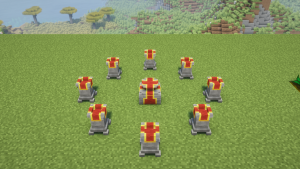
The  Apple Press is one of the first machines you’ll want to build in Let’s Do Vinery, and it’s used to handle the apple side of the mod. Grapes are dealt with by the
 Grapevine Pot instead, but apples are brought here, and the juice that comes out of it is what the
 Fermentation Barrel will later turn into
 Cider and
 Apple Wine.
If you’ve come across the mod inside a modpack, then this is the easier of the two chains to get started with.  Apples can be taken from any oak tree, or from the mod’s own
 Apple Trees, which means you can be pressing juice within minutes of building one. Grapes take a lot longer to get going, as they need seeds,
 Stems and a season of growing first.
The press is used to do two jobs in the same block, one after the other. Whatever you put into it is mashed down first, and then that mash is pressed into a bottle. It’s moved between the two stages on its own, so there’s nothing for you to shuffle around.
Obtaining
Nothing from Vinery itself is needed to craft one, just an  Iron Trapdoor, a
 Barrel and some
 Sticks. So it’s one of the first things you can build after installing the mod, and you won’t have to grow anything beforehand.


Before you place it, you’ll want to make sure there’s some headroom, as the press is 2 blocks tall. Only the lower half of it opens, with the top being the frame, which means the bottom block is the one you’ll need to right click.
Usage
Loading the Press
To get started, drop an Apple into the input slot on the left. It’ll be mashed over 30 seconds into  Apple Mash, which the press then moves across into the middle slot by itself. You won’t have to touch anything in between.

Nothing is lost if you happen to interrupt it part way through. Break the press mid-batch and everything inside can be picked straight back up, which means a working setup can be moved without waiting for it to finish.
The Pressing Stage
The second stage needs an empty  Wine Bottle to be sitting beside the mash. Once one’s there, 40 seconds are spent turning that mash into
 Apple Juice, and the filled bottle is dropped into the output slot on the right. Each press will use one up, so it’s worth keeping a few in there, rather than just the one.

If nothing seems to be happening, then check that slot first. Mashing is able to run without a bottle, so mash can pile up in the middle, with no juice coming out. It tends to look like a jam, when really the press is just waiting.
Both stages can also run at the same time, which matters once you’re trying to make juice in bulk. A fresh Apple can be mashing while the last one is being pressed. So a press you keep loaded will give you a bottle every 40 seconds, instead of every 70.
Recipes
There are only four recipes here, and they’re really two chains rather than four separate things. Apples are turned into juice,  Honeycomb Blocks are turned into
 Honey Bottles, and both of them pass through the same mash then press process.
| Stage | You put in | You get | Takes | Wine Bottle |
|---|---|---|---|---|
| Mashing | Apple | 1 Apple Mash | 30 seconds | No |
| Mashing | Honeycomb Block | 4 Honeycomb | 30 seconds | No |
| Pressing | Apple Mash | 1 Apple Juice | 40 seconds | Yes |
| Pressing | Honeycomb | 1 Honey Bottle | 40 seconds | Yes |
They both run through the same two stages and the same slots, which means nothing changes about how the press is loaded. Only what you put into the first slot is different.
The Honey Route
Most people miss the honey route entirely. A Honeycomb Block can be mashed into 4  Honeycomb, and each of those is pressed into a Honey Bottle, so one block and 4 Wine Bottles will be enough to get you 4 of them. 6 of the wine recipes call for one, which makes it worth a run before you start brewing.
Mechanics
Mashing takes 30 seconds and pressing takes 40, so your first bottle should arrive about 70 seconds after loading. These are config values though, which means a pack might have shortened either of them.
Hoppers and Automation
 Hoppers do work on the press, with one limit that’s worth knowing about. Any of the four sides can be fed by one, and the input slot, the mash slot and the bottle slot are all reachable. A Hopper underneath will pull juice out of the output slot.
What none of them are able to do is take mash back out of the middle. Only the output slot can be extracted from, which means the mash has to be pressed where it sits. An automated line that isn’t being fed Wine Bottles will just fill up with mash and stop.
Sit a press on a Hopper feeding a  Chest, or feeding the Fermentation Barrel itself, and the apple chain can be left to run on its own. Break it and everything inside drops, so you’re able to move a working setup without losing what’s in it.
FAQ
Put an Apple into the left slot of an Apple Press, and an empty Wine Bottle into the bottle slot. It’s mashed for 30 seconds, then 40 more are spent pressing that mash into Apple Juice, and the filled bottle is dropped into the output slot on the right.
Nothing needs to be moved between the two stages, as the mash is passed along by the press itself. So a loaded press will be able to keep producing without you.
Check the bottle slot first. Mashing is able to run without a Wine Bottle, so Apples will still be turned into Apple Mash, though the pressing stage won’t start until one is sitting beside it.
It’s worth checking the output slot as well, as a finished bottle that’s left in there can block the next one. A Hopper underneath will be enough to keep it clear.
The Apple Press is used to make them, which is the part most people miss. Feed it a Honeycomb Block and it’ll mash into 4 Honeycomb, and then each of those is pressed into a Honey Bottle with a Wine Bottle.
That’s 4 Honey Bottles from a single Honeycomb Block. 6 of the wine recipes call for one, which makes it worth a run before you start brewing.
Neither of them can be made in the press. Only the Apple Juice comes from it, and the brewing is done afterwards in the Fermentation Barrel.
Cider takes 20% of a barrel of Apple Juice, plus  Sugar and a Wine Bottle. Apple Wine takes 15% plus an Apple Juice in the ingredient slots, which makes it one of the 7 recipes that needs no bottle.