Mars is the second planetary destination in Ad Astra and your first major progression milestone after the Moon. The red planet sits behind a  Tier 2 Rocket requirement and introduces three new biomes, a unique hostile mob, and four mineable ores.
Most importantly, Mars is your gateway to  Ostrum, the material you need to build a
 Tier 3 Rocket and craft the Netherite Space Suit for the extreme heat of Venus and Mercury.
At Tier 2, Mars hits you with three simultaneous survival threats: no breathable oxygen, freezing temperatures of -65°C, and gravity at only 38% of Earth’s. Come prepared with a full  Space Suit and enough
 fuel for the return trip, and Mars pays back handsomely with Ostrum,
 Diamonds, and
 Ice Shards for
 Cryo Fuel production.
Getting There
Reaching Mars requires a Tier 2 Rocket, which you build at the  NASA Workbench using
 Desh components instead of the
 Steel used for the
 Tier 1 Rocket. You need a
 Rocket Nose Cone,
 Desh Blocks,
 Desh Tanks, a
 Desh Engine, and
 Rocket Fins. All of the Desh comes from the Moon, so make sure you have mined enough before attempting this build.





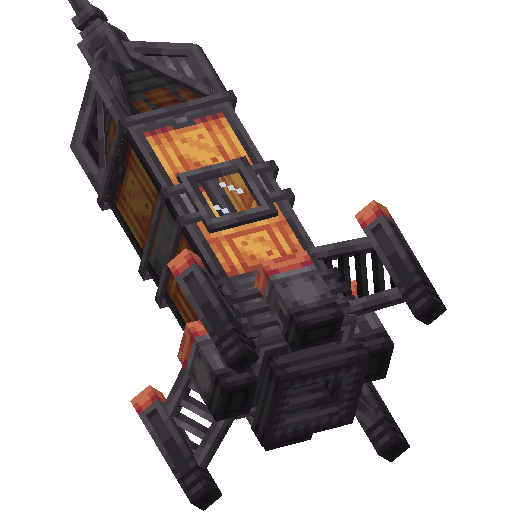
The Tier 2 Rocket uses standard Fuel Buckets, though Cryo Fuel is significantly more efficient. Once built and fueled, place the rocket on a  Launch Pad and right-click to open the planet selection screen. Select Mars from the Solar System view and launch. You pass through Mars Orbit on the way down and land on the surface with a Lander.

The  Tier 1 Rover works on Mars and is useful for covering ground without burning through oxygen faster than necessary. It has its own storage inventory and supports two riders, making it a practical choice for extended surface runs. Craft the Rover from Desh components on the Moon before your trip.
You must wear a complete Space Suit (Helmet, Chestplate, Leggings, and Boots) loaded with oxygen to survive on Mars. Any missing piece means no oxygen supply, and you begin taking suffocation damage immediately. Charge the Space Suit Chestplate at an Oxygen Loader before you leave, and bring spare oxygen for refilling during extended stays.







Environment
Atmosphere

Mars has no breathable atmosphere. Outside of a sealed oxygen bubble created by an  Oxygen Distributor, you rely entirely on the oxygen stored in your Space Suit Chestplate. The suit consumes oxygen every 12 ticks when you stand outside an oxygen zone, and drains extra oxygen while you are submerged in liquid. Running out of oxygen mid-mission is the most common way to die on Mars, so track your suit’s fluid bar and return to base before it empties.
Temperature

The surface temperature on Mars is -65°C, which falls below the safe range of -50°C to 70°C. A standard Space Suit handles this cold without issue, so you do not need a Netherite Space Suit for Mars. Save that upgrade for Venus (464°C) and Mercury (167°C), where the heat is lethal without it.
Gravity
Mars has a gravity of 3.72 m/s², about 38% of Earth’s 9.807 m/s². You jump noticeably higher and fall much more slowly, which makes traversal feel floaty. Fall damage calculations change accordingly: you can survive falls from greater heights, which is useful when descending into caves. Watch out for canyon edges and open drops during combat, because the slow fall speed carries you much further horizontally than expected before you land.
Biomes
Mars contains three distinct biomes. The majority of the planet features rust-colored terrain with a reddish-orange sky and crimson spore particles drifting through the air. All biomes share the same cave system (standard cave, extra underground cave, and canyon carvers), and all spawn  Martian Raptors as the only natural hostile mob.

Below Y 87, the terrain is solid Mars Stone. Above Y 87, the surface block changes depending on which biome you are in.
Martian Wastelands
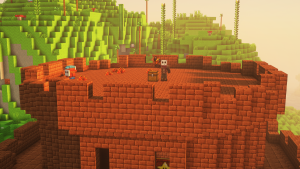
The Martian Wastelands is the most common biome and covers the majority of the planet’s surface. Terrain here is open and rolling, with  Mars Sand blanketing everything above Y 87. This biome generates Mars Temples and is the most important area to explore early on.
Martian Canyon Creek
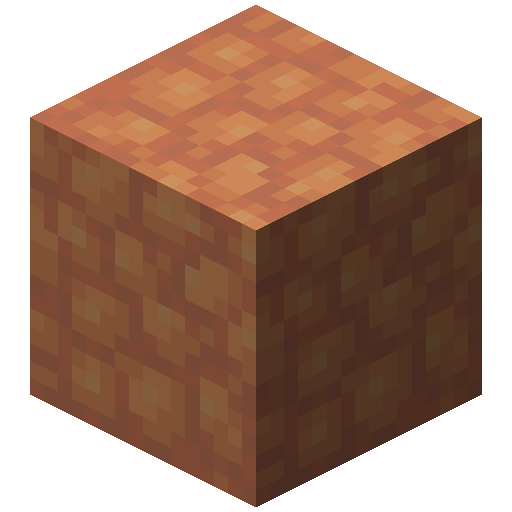
The Martian Canyon Creek features canyon-carved terrain and scattered surface clusters of  Conglomerate, a decorative stone unique to Mars. It shares the same ore distribution and structure generation as the Wastelands, so Mars Temples also spawn here.
Martian Polar Caps
The Martian Polar Caps is a cold, icy biome identifiable by Ice Spike formations and ice patches on the surface. Instead of Mars Sand, the surface here is  Snow Block. The Polar Caps do not generate Mars Temples, but they are an efficient place to farm Ice Shard Ore since the ore spawns densely at mid-depth.
Resources
Mining is the main reason to visit Mars. The planet contains four ores, each distributed at different Y levels in Mars Stone. All four ores generate in all three biomes, so your biome choice only affects surface terrain, not underground resources.
Ostrum
 Mars Ostrum Ore is the primary goal of any Mars mission. It drops
 Raw Ostrum, which smelts into Ostrum Ingots used for the
 Ostrum Engine, Tier 3 Rocket components, and the
 Netherite Space Suit.

Ostrum Ore generates in veins of up to 8, with 8 veins per chunk across a wide Y range of -80 to 80 (trapezoid distribution peaking around Y 0). It has a 50% chance to discard its drop when exposed to air, so dig into solid rock rather than following cave networks for the best yield.
Other Ores
 Mars Iron Ore is the most abundant and shallow ore on Mars. It generates in veins of up to 11, with 10 veins per chunk from Y -24 to Y 56. You likely brought plenty of iron from Earth, but it is useful for emergency crafting if you run short on supplies.
 Mars Ice Shard Ore drops Ice Shards, which you process in a
 Cryo Freezer to produce Cryo Fuel. Cryo Fuel is roughly three times as efficient as regular fuel: one bucket launches any rocket tier compared to three buckets of refined fuel.
Ice Shard Ore generates in veins of up to 10, with 8 veins per chunk from Y -32 to Y 32. Each Ice Shard converts to approximately 25 milli-buckets of Cryo Fuel, so around 40 shards fill a full launch bucket.

 Mars Diamond Ore drops standard Diamonds with Fortune or Silk Touch behavior. It generates in veins of up to 7, with 5 veins per chunk from Y -80 to Y 80. Like Ostrum Ore, it has a 50% chance to discard its drop when exposed to air, so solid rock mining outperforms cave scavenging.
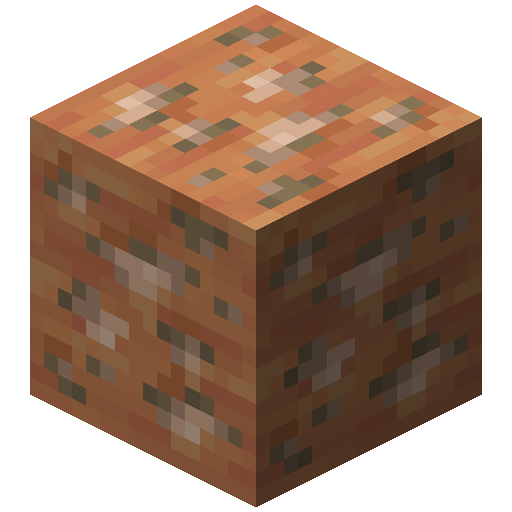
Mars Iron Ore
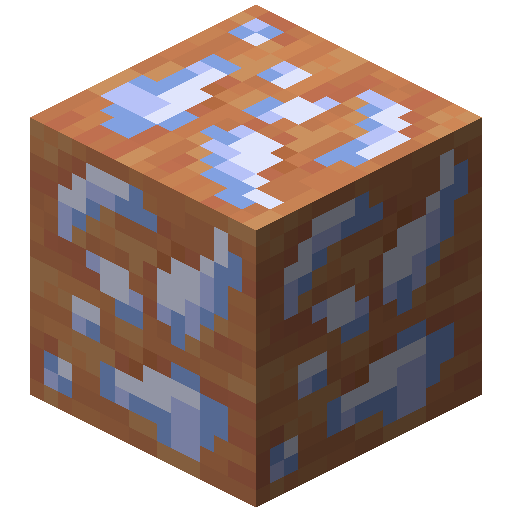
Mars Ice Shard Ore
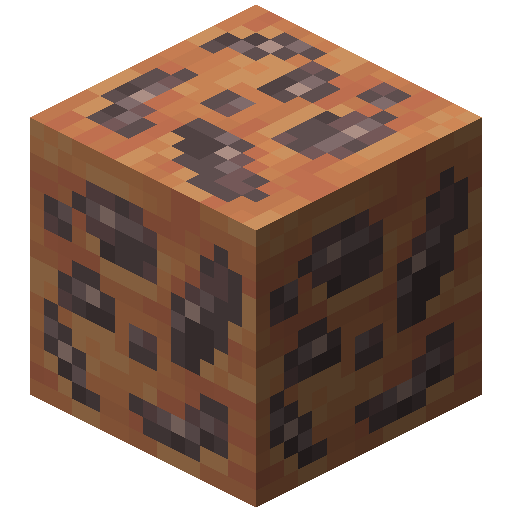
Mars Ostrum Ore

Mars Diamond Ore
All Mars Stone you mine becomes Mars Cobblestone, which you can smelt back into Mars Stone and then craft into Mars Stone Bricks, Polished Mars Stone, Pillars, Slabs, Stairs, and Walls for decoration. The Conglomerate blobs found on the surface of the Martian Canyon Creek biome are also harvestable and can be polished into Polished Conglomerate for building.
Structures
Mars Temple
The Mars Temple is the only naturally generating structure on Mars. It appears in the Martian Wastelands and Martian Canyon Creek biomes but does not spawn in the Martian Polar Caps.

Mars Temples are surface structures with moderate frequency, spawning with a spacing of 40 chunks and a minimum separation of 27 chunks. Each temple contains a loot chest with 3-8 item rolls from the pool below.
Mars Temple Chest
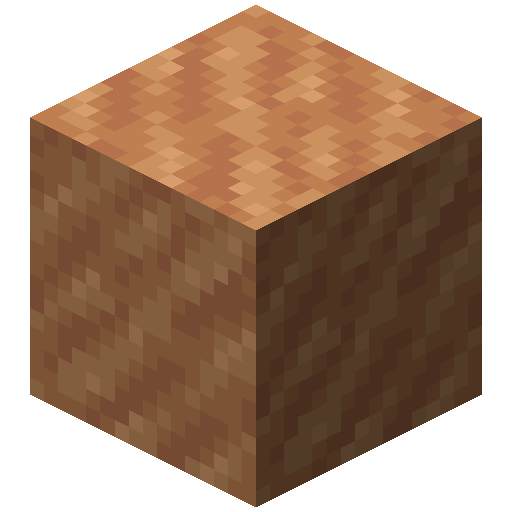 Mars Sand

 Ice

 Emerald

 Enchanted Book
 Ice Shard

 Iron Ingot

 Bone

 String

 Rotten Flesh

 Golden Apple
 Raw Ostrum
 Diamond

 Redstone Dust

 Stick

 Glow Berries

 Suspicious Stew

 Enchanted Golden Apple
Mobs
Martian Raptor
The Martian Raptor is the only mob that spawns naturally on Mars. It appears in all three biomes in groups of 1 to 3 and is hostile on sight. You will encounter Raptors regularly while exploring the surface and moving between ore veins.

Low gravity affects knockback during combat, so stay aware of open drops and canyon edges while fighting. The Martian Raptor has its own dedicated article covering its drops, attack patterns, and behavior in detail.
 Lunarian Wandering Traders occasionally roam the Martian surface, just as they do on other planets and moons. Keep an eye out for them: their trades can include Launch Pads and oxygen fuel, which makes them a genuine lifeline if you miscalculated your return trip supplies.
Building a Base
Setting up a base on Mars follows the same pattern as the Moon, but with a few key differences in power generation and some welcome quality-of-life features.
Power
Mars receives less solar energy than Earth or the Moon.  Solar Panels produce 12 FE/t here compared to 16 FE/t on Earth and 24 FE/t on the Moon, so you need more panels or a supplementary
 Coal Generator to run your machines at full capacity.
If you build a Space Station in Mars Orbit, Solar Panels produce 24 FE/t there, making orbit a better location for power-hungry setups.
Oxygen and Pressurization
An Oxygen Distributor connected to a power source fills an enclosed structure with breathable air, letting you remove your Space Suit inside. Seal any structure you build with  Airlocks at doorways to keep oxygen from escaping when you enter and exit.
A  Gravity Normalizer restores standard gravity within its range, which makes building and general movement feel more comfortable during long stays.

Beds work on Mars. You can sleep normally to skip the night and set your spawn point, so dying to Martian Raptors while getting established respawns you on Mars rather than sending you back to Earth. Respawn Anchors do not work here, so beds are the only way to set a local spawn point.
Tips
Target Y 0 for Ostrum and Diamond mining. Both ores distribute across a wide Y range (Y -80 to Y 80) with peak density around Y 0, and both have a 50% chance to discard their drops when exposed to air. Strip-mining in solid  Mars Stone at Y 0 gives you the highest ore yield per block broken.
Head to the Martian Polar Caps if Ice Shards are your priority. Ice Shard Ore generates from Y -32 to Y 32 and reaches peak density near Y 0. The Polar Caps biome does not spawn Mars Temples, so you can focus on mining without surface distractions.
Normal  Torches and
 Lanterns do not stay lit on Mars outside of a sealed oxygen zone. Bring
 Soul Torches or
 Glowstone for lighting when exploring caves or working in unsealed areas.
 Lunarian Villagers sell Soul Torches, so stock up before you leave the Moon.
Always bring enough fuel for a return trip. Mars has no renewable fuel source on the surface, so if you arrive with only enough for the outbound journey, you are stranded until you smelt Mars Iron Ore and craft more. Carrying two Fuel Buckets (or one Cryo Fuel Bucket) covers the round trip.
The Space Suit provides more armor protection than many players expect. A common approach when first arriving is to push straight into resource gathering despite Raptor encounters, since the suit handles the damage well enough. Prioritize oxygen management over fighting, and retreat when your suit’s fluid bar gets low rather than standing your ground.
Bring a spare set of oxygen. Your Space Suit Chestplate drains continuously outside an oxygen zone, and being underwater drains it faster. Keep a Gas Tank or extra filled Oxygen Bucket in your inventory so you can refill without returning to base during long cave runs.
FAQ
No. The standard Space Suit handles Mars’s -65°C temperature without issue. The Netherite Space Suit is required for Venus (464°C) and Mercury (167°C), which have extreme heat. Craft the Netherite Space Suit on Mars using the Ostrum you mine there before moving on to Tier 3 planets.
Yes. Beds work normally on Mars. You can sleep to skip the night cycle and set your spawn point on the planet. Respawn Anchors do not work on Mars, so beds are your only option for setting a local spawn. Sleeping on Mars is safe and encouraged for keeping a respawn point close to your mining operation.
Strip-mine in solid Mars Stone at Y 0. Ostrum Ore spans Y -80 to Y 80 with a trapezoid distribution peaking around Y 0. Because it has a 50% chance to discard its drop when exposed to air, mining in solid rock rather than following existing caves gives you a much better yield. The same depth range also contains Mars Diamond Ore, so you find both at once.
No. Despite appearing in Mars-related contexts in many guides, Pygros, Pygro Brutes, Moglers, Zombified Pygros, and Zombified Moglers all spawn on Venus, not Mars. The only naturally spawning hostile mob on Mars is the Martian Raptor, which appears in all three biomes.
Mars is farther from the Sun than Earth, so it receives less solar energy. Solar Panels produce 12 FE/t on Mars compared to 16 FE/t on Earth. Build more panels or add a Coal Generator to compensate. Mars Orbit produces 24 FE/t, so a Space Station in orbit is a better location for solar power generation.
Building a Space Station in Mars Orbit requires 64 Iron Plates, 32 Steel Ingots, 32 Desh Ingots, and 32 Desh Plates. You assemble these in the planet selection screen when you have all materials in your inventory. The Mars Orbit station generates 24 FE/t from Solar Panels, making it a strong location for power-intensive setups like Etrionic Blast Furnaces.
No. Ice Shard Ore appears on cold planets in Ad Astra, including Glacio. However, Mars is the first cold planet you visit, making it your initial source of Ice Shards for Cryo Fuel production. The Moon also has Moon Ice Shard Ore available earlier, so you may already have experience with this resource from Tier 1 exploration.